Overview
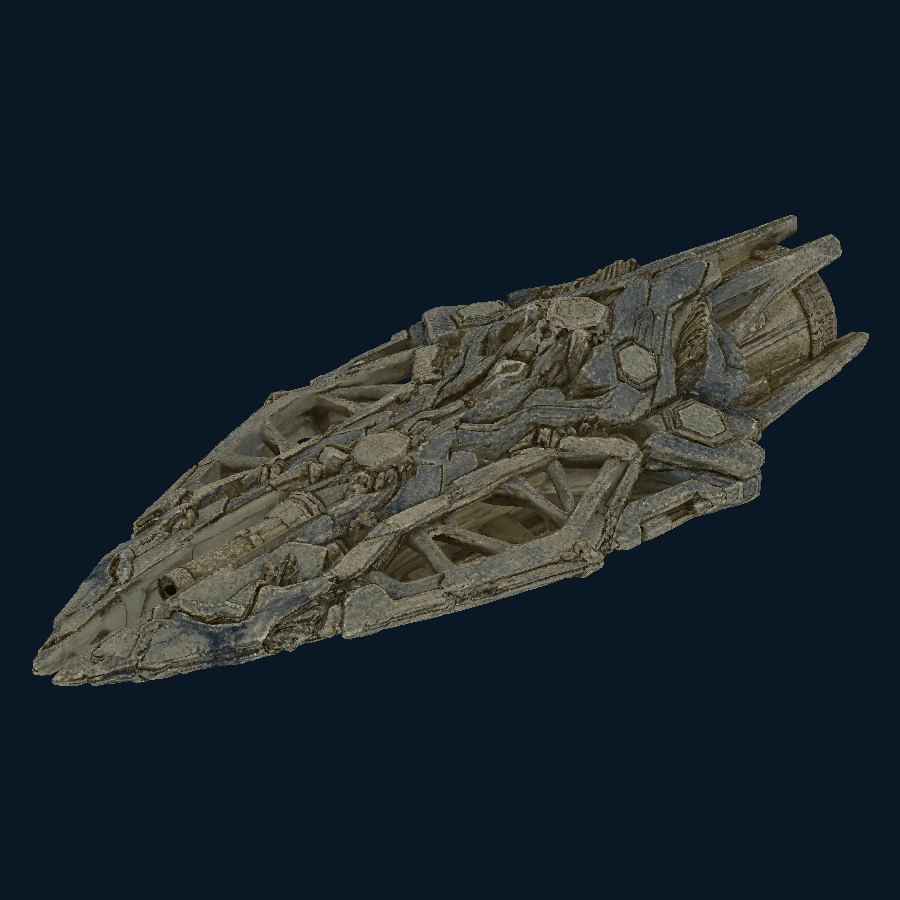
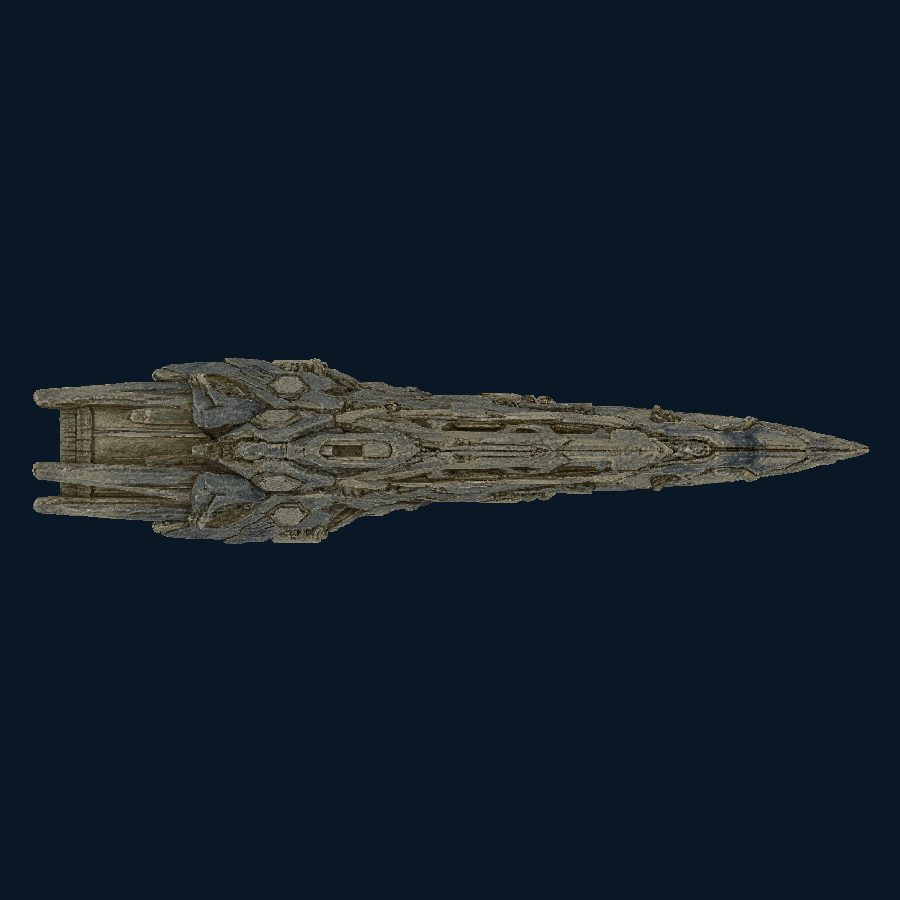
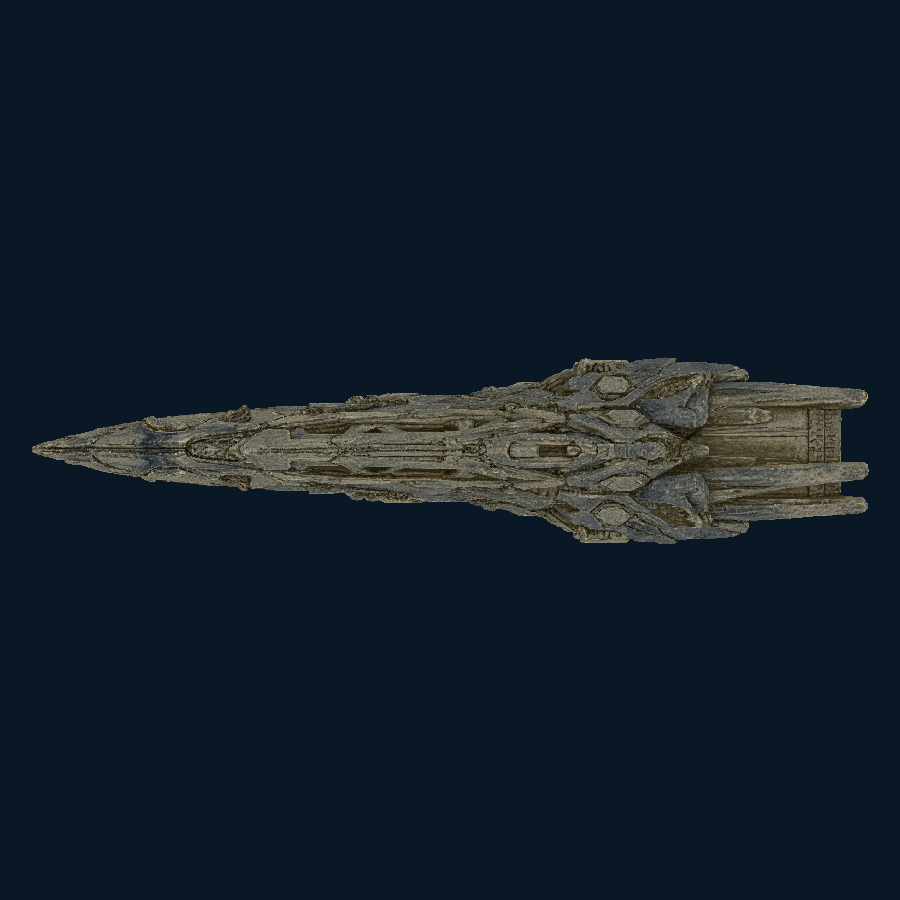
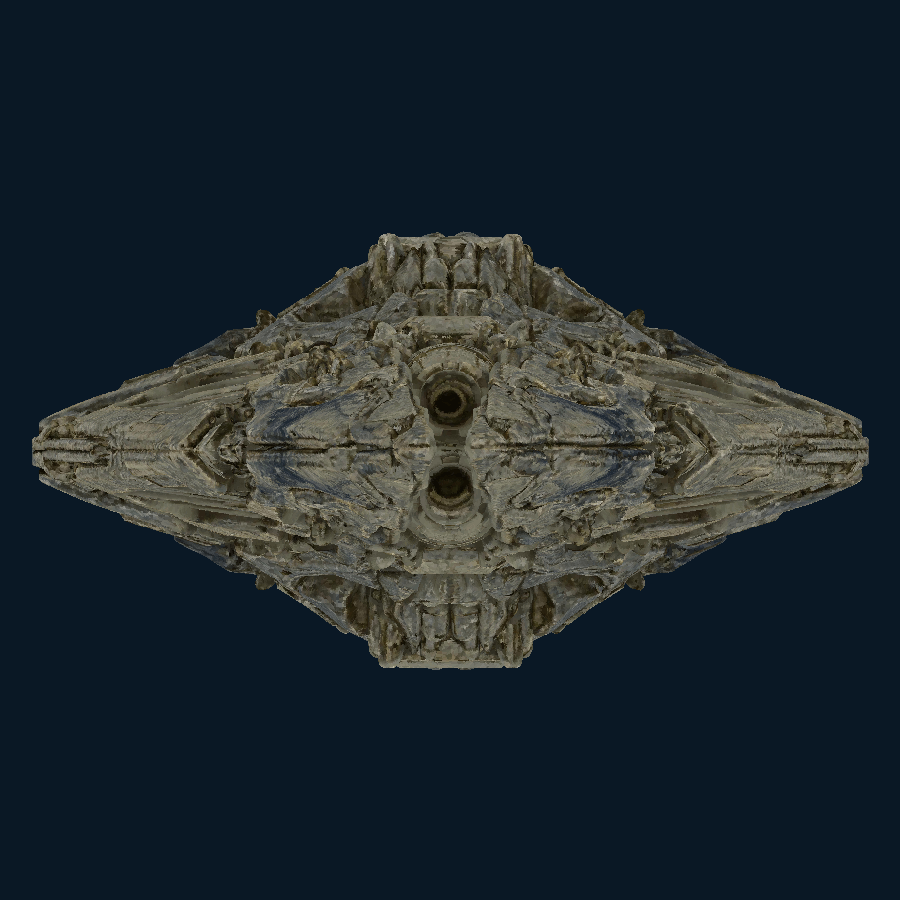
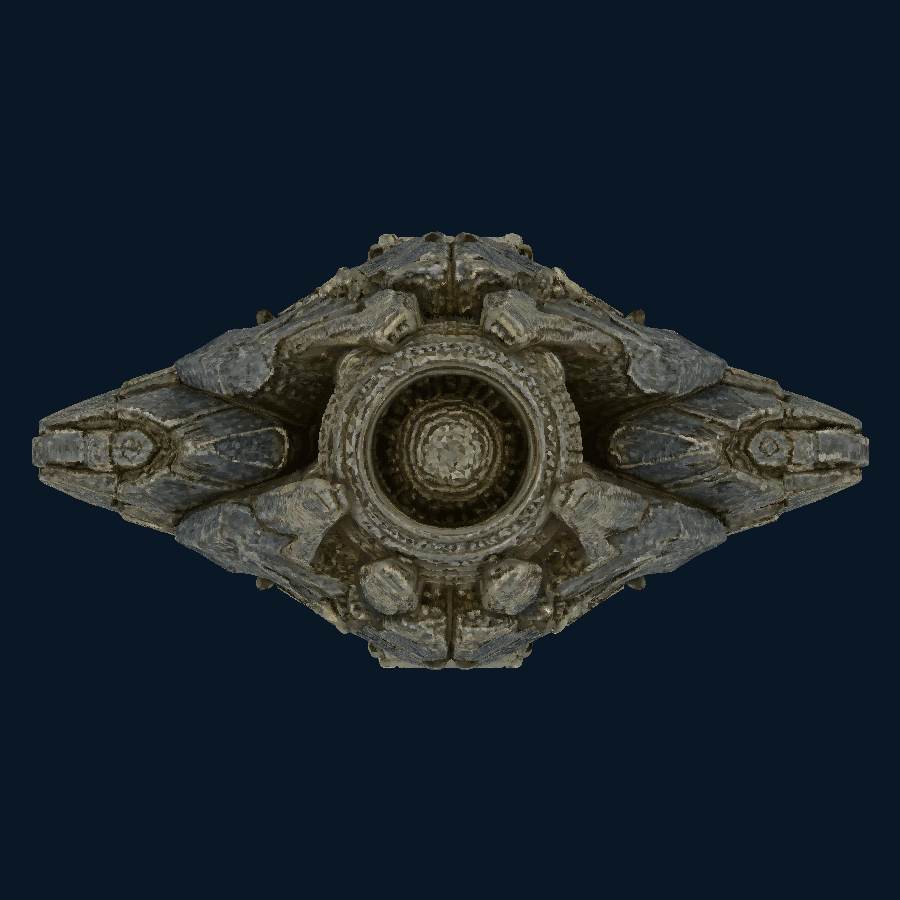
A naturally cultivated Cryvum cruiser built for independent, long-range operations. Its pyrite-derived crystal-metal body integrates attack, protection, propulsion, and cognition into one continuous lattice. Human reporting name: Brassfold Traverse-class Cruiser. Mineral lineage: Pyrite. A substantial forward mass, deep central body, and fuller rear shoulders balance offensive focus with sustained protection.
Vessel Profile
Weapons&Armament
The forward crystal region concentrates attack through coordinated lattice resonance. The proposed combat doctrine favors deliberate frontal engagements and timed disruption of a target’s structural coherence. There are no external guns, turrets, launch apertures, or weapon pods; the crystal body itself forms the focusing medium. Effective range and discharge rate remain balance parameters.
Dimensions & Scale
Length 900 m × Width 428 m × Height 217 m. Fictional overall dimensions in standard operating configuration.
External Anatomy
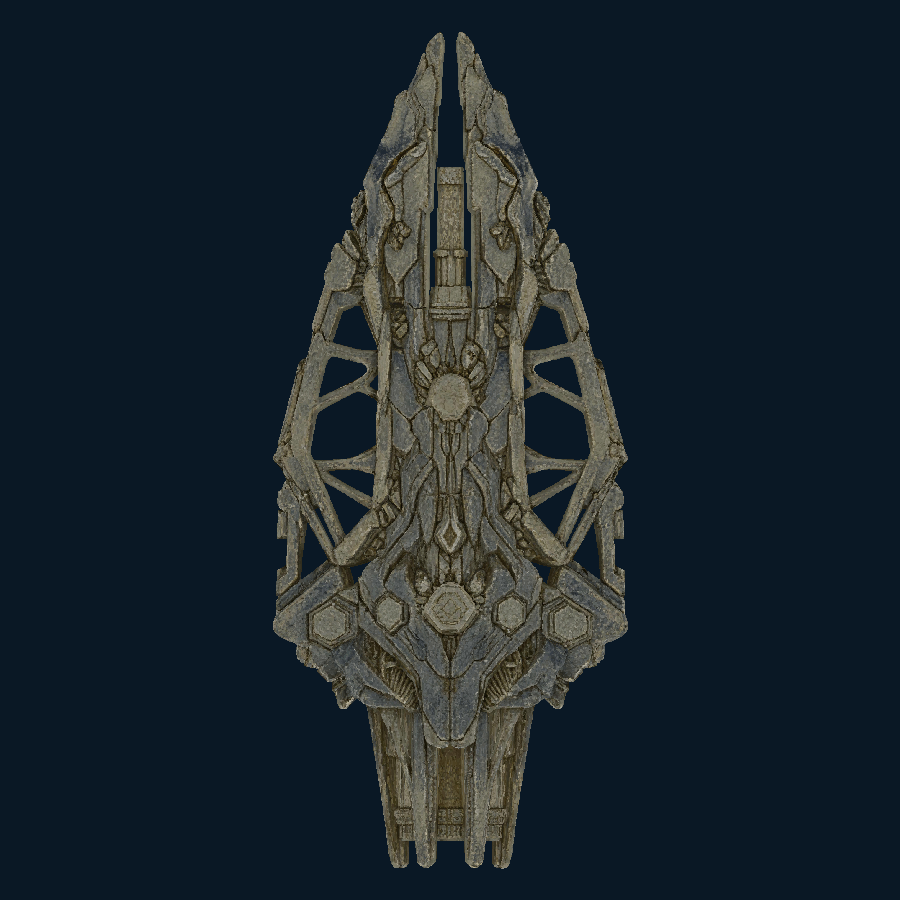
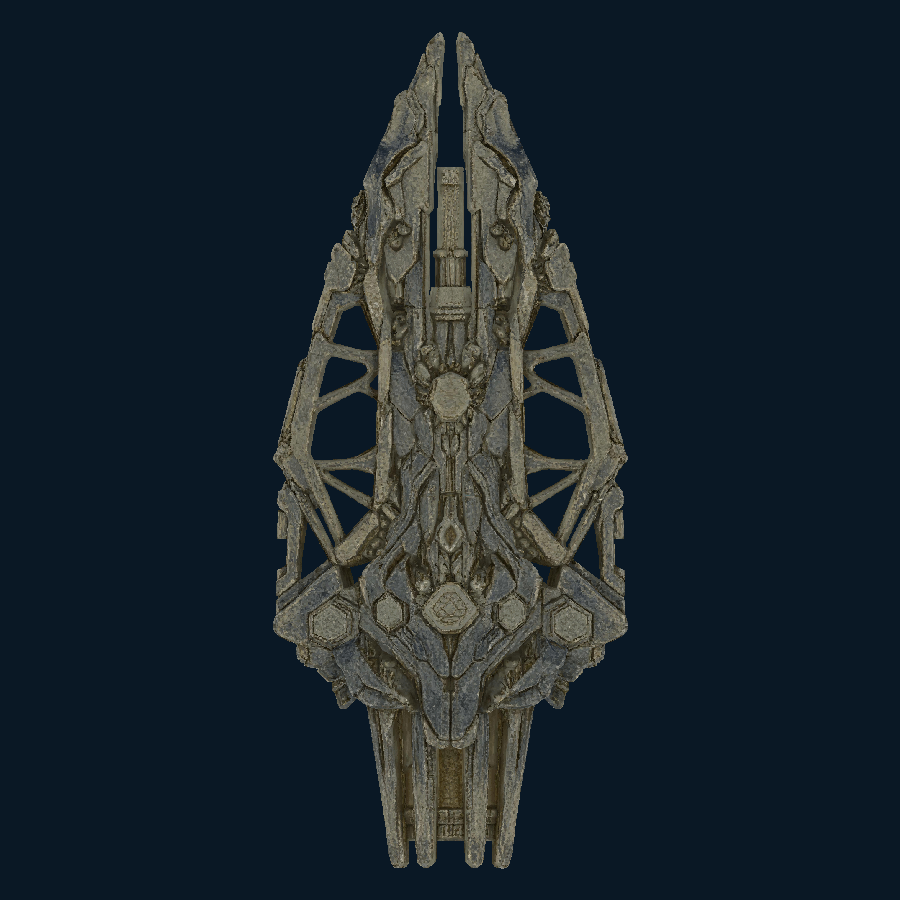
A thick prow joins a deep central body and broad rear shoulders. Rooted structural growths share the load across a continuous hull, protecting buried attack, defense and propulsion regions.
Functional Architecture
Attack resonance is coordinated in the forward domains; shoulder and flank roots redistribute defensive repulsion; rear intergrowth biases the field for motion. Cognition, sensing, stored energy, habitation volume, and mineral reserves remain inside the lattice. These functions are expressed through crystal orientation, density, grain, and restrained subsurface optical depth.
Technical Specifications
Offensive rating: 60/100 — The forward crystal region concentrates attack through coordinated lattice resonance
Defensive rating: 63/100 — Shoulder and flank roots distribute repulsion across the continuous crystal-metal body
Mobility rating: 44/100 — Maneuvering supports the formation and mission profile rather than unrestricted pursuit
Tactical cognition rating: 60/100 — Target assessment, formation coordination and response timing support traverse-class cruiser operations
Endurance rating: 49/100 — Mission duration depends on finite reserves, damage recovery and scheduled replenishment
Fleet support rating: 27/100 — Operational doctrine: independent route patrol, convoy escort, reinforcement interception, and cruiser-led flank control
Fleet Role
Proposed doctrine: independent route patrol, convoy escort, reinforcement interception, and cruiser-led flank control. Brassfold should establish a favorable forward firing axis, absorb limited return pressure through its shoulder domains, and reposition before prolonged discharge degrades lattice coherence. In a fleet, it anchors a mobile cruiser screen rather than replacing a siege battleship or carrier.
Life Between Stars
Rear crystal intergrowth biases the propulsion field, while coordinated lattice domains govern attitude changes. The hull remains a single flight-body without conventional exhaust nozzles or attached thrusters. Proposed operational behavior favors stable long-range transit and deliberate combat repositioning over fighter-like pursuit. Specific transit range and acceleration are not yet defined.
Defense Architecture
Shoulder and flank roots distribute repulsion across the continuous crystal-metal body. The deep central parent mass and buried stress spine provide structural continuity. Proposed defensive doctrine alternates concentrated forward attack with a wider protective field, avoiding simultaneous maximum output in every domain.
Operational Limits
Proposed balance constraints: sustained attack and protection compete for finite stored energy and lattice stability. Damage across deep shared roots can impair several functions at once. Wide flanking pressure disrupts the preferred frontal engagement geometry; repeated rapid turns and prolonged discharge impose coherence strain. Regrowth requires appropriate mineral reserves and recovery time. These are design constraints, not measured performance results.
Strategic Strengths
A balanced independent-combat profile; substantial structural depth; integrated sensing and field coordination; strong forward attack focus; and distributed shoulder defense. The large, coherent domains favor sustained, controlled encounters and convoy protection. Its mineral growth architecture avoids dependence on exposed bridges, turrets, or engine pods.
Capability Assessment
A regular fleet cruiser with balanced frontal attack, protection and sensing. Its moderate endurance and limited support capacity favor coordinated patrols rather than independent capital-ship engagements.
C · 50.5
Editorial profile, 0–100. Fleet-wide concept rating; not a simulated combat result or a ranking of a species'intelligence. Grade uses the equal-weight mean: S ≥ 90, A ≥ 75, B ≥ 60, C ≥ 45, D<45. Tactical Cognition describes sensing, coordination and command.
Technology Level
Proposed T2 — integrated lattice-field propulsion and phase-compatible operations. This is a concept classification, not a measured gameplay result.
Weapon Class
Proposed W2 — heavy fleet engagement through focused crystal resonance. No strategic world-scale weapon capability is assigned.
T0 planetary · T1 system flight · T2 phase travel · T3 limited world engineering. W0 point defense · W1 ship combat · W2 heavy fleet combat · W3 strategic theater systems. Technology and weapon classes are independent of the profile grade.
History & Lineage
Origin
Cultivated for independent escort duty along the fractured Veyr Passage
Lineage & Branch
Brassfold Traverse cruiser lineage; Lantern Route branch
Fleet or Unit
Lantern Route Watch
Individual History
The First Traverse — Brassfold earned its reporting name while escorting mineral-seed transports across the fractured Veyr Passage. Rather than outrunning the drifting debris, the cruiser held a slow, steady course and used its shoulder repulsion domains to open a corridor for the convoy. Every transport reached the far anchor. The passage crews began calling the route the Brassfold Traverse.
The Silent Reef Ambush — At the Silent Reef, Bugvex attachment organisms concealed themselves among spent mineral fragments. Brassfold survived the first assault, but its overlapping aft growths trapped several feeding colonies against deep shared roots. A prolonged resonance discharge damaged the invaders and fractured part of the cruiser’s own port shoulder. Brassfold withdrew behind its escorts instead of pursuing the brood. The dark seam left by that engagement remains in its regrown hull, preserved as a warning against fighting alone inside a debris field.
The Lantern Convoy — During the evacuation of the Lantern Reefs, Brassfold received a distress call from a damaged human rescue vessel stranded beyond the convoy screen. Its commander diverted the cruiser and turned the scarred port shoulder toward the approaching hunters, shielding the rescue vessel while the remaining transports crossed the exit anchor. Brassfold returned with depleted reserves and a dormant forward attack lattice. For the first time, its recovery manifest listed human survivors alongside Cryvum mineral-seeds.
A Scar Kept in Memory — Brassfold now patrols the routes between recovering reef settlements. The vessel’s cognitive lattice retains the Lantern rescue signal as a departure ritual: before each patrol, the bridge crews of visiting human ships hear the same three quiet pulses that once announced an open path home.