
Overview
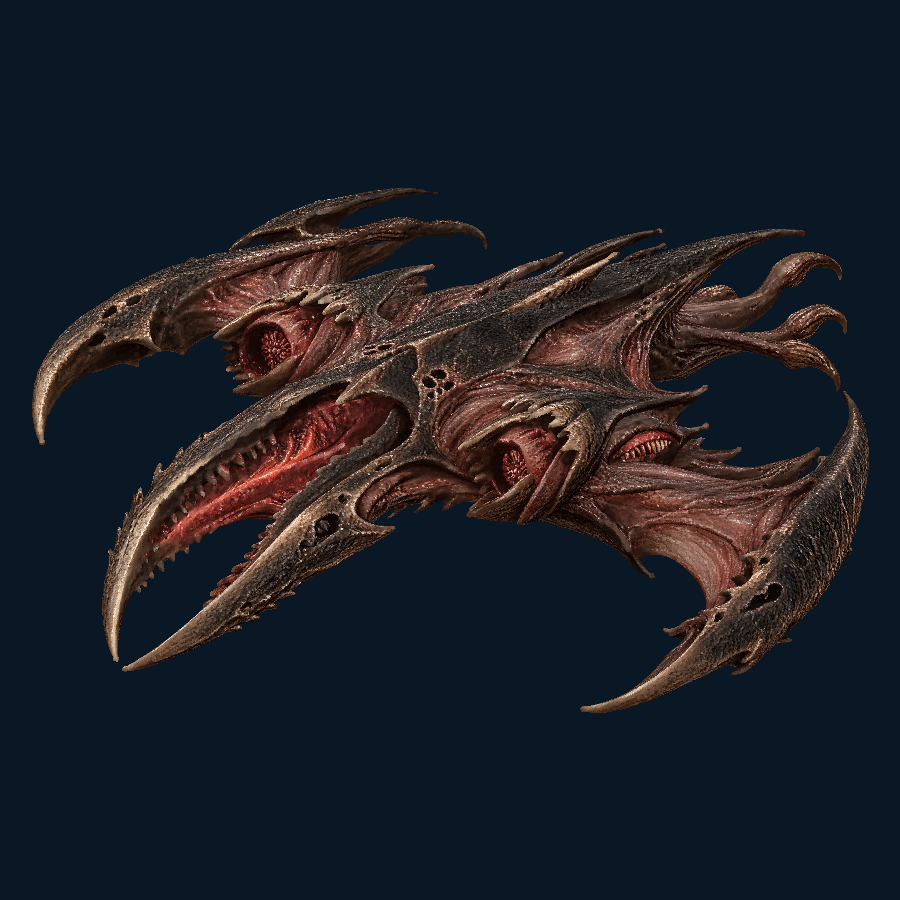
Night Crown-class Interceptor is a Bugvex void organism specialized for rapid interception along contested field boundaries. Its low, continuous living body combines a sensory leading edge, muscular steering membranes and locally hardened growths. Movement, attack and recovery depend on coordinated tissue activity throughout the organism rather than separate engines or mounted equipment.
Organism Profile
Dimensions & Scale
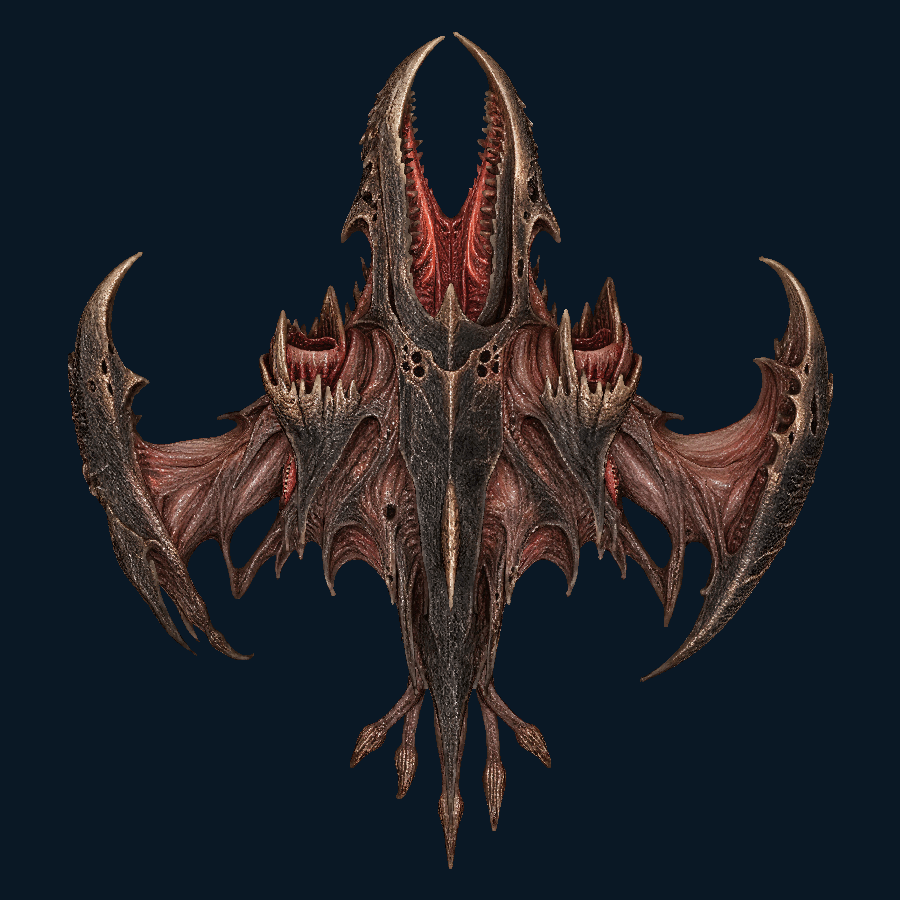
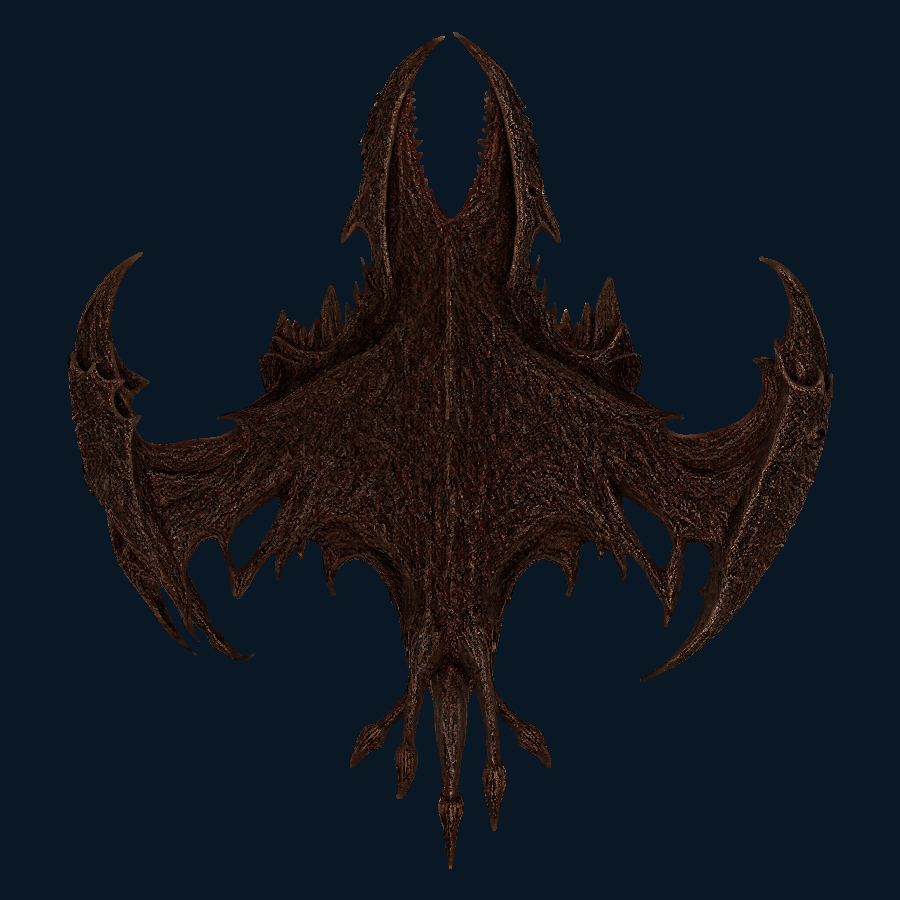
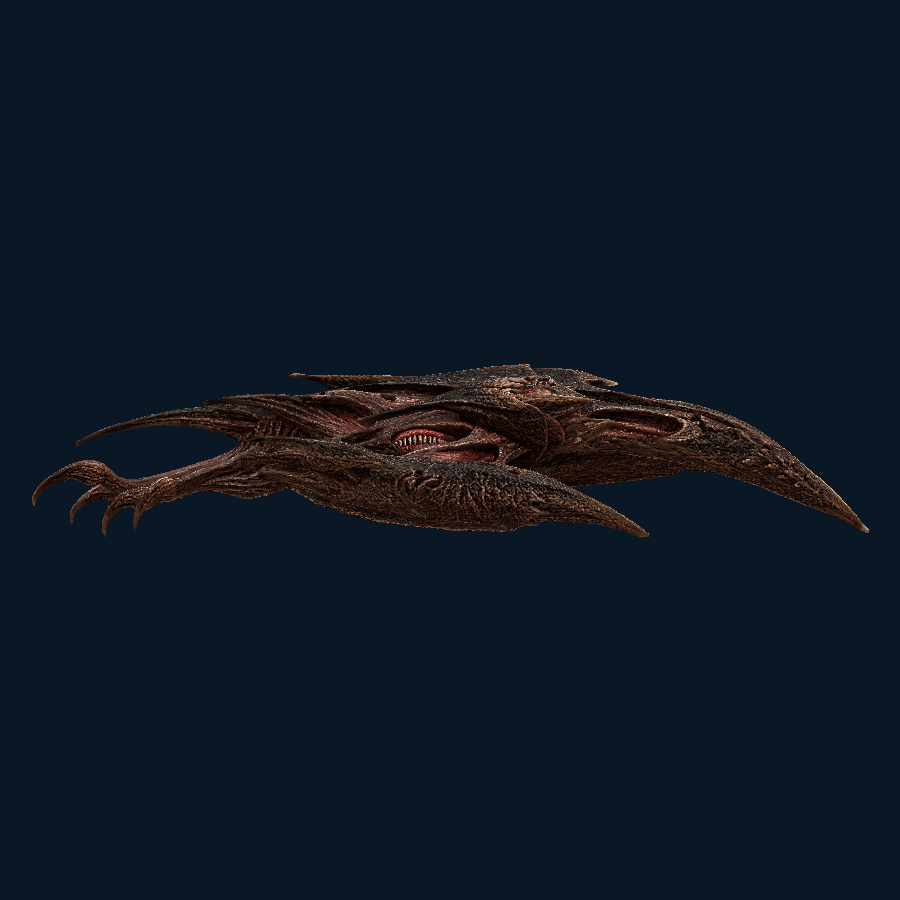
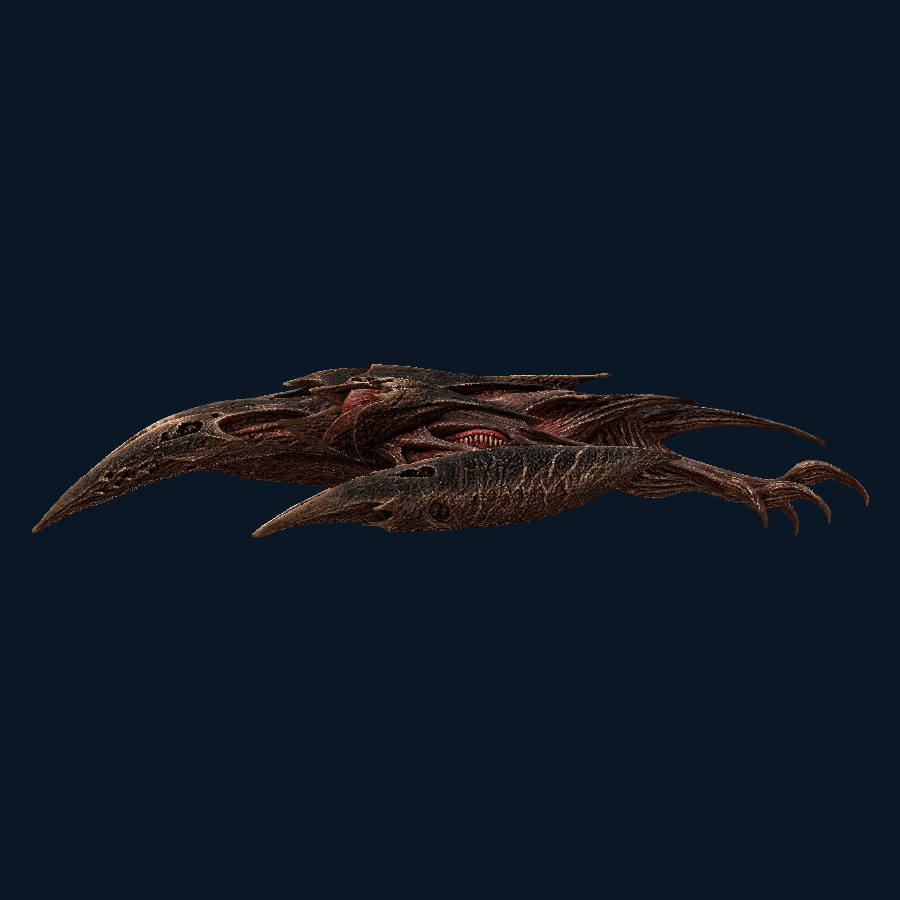
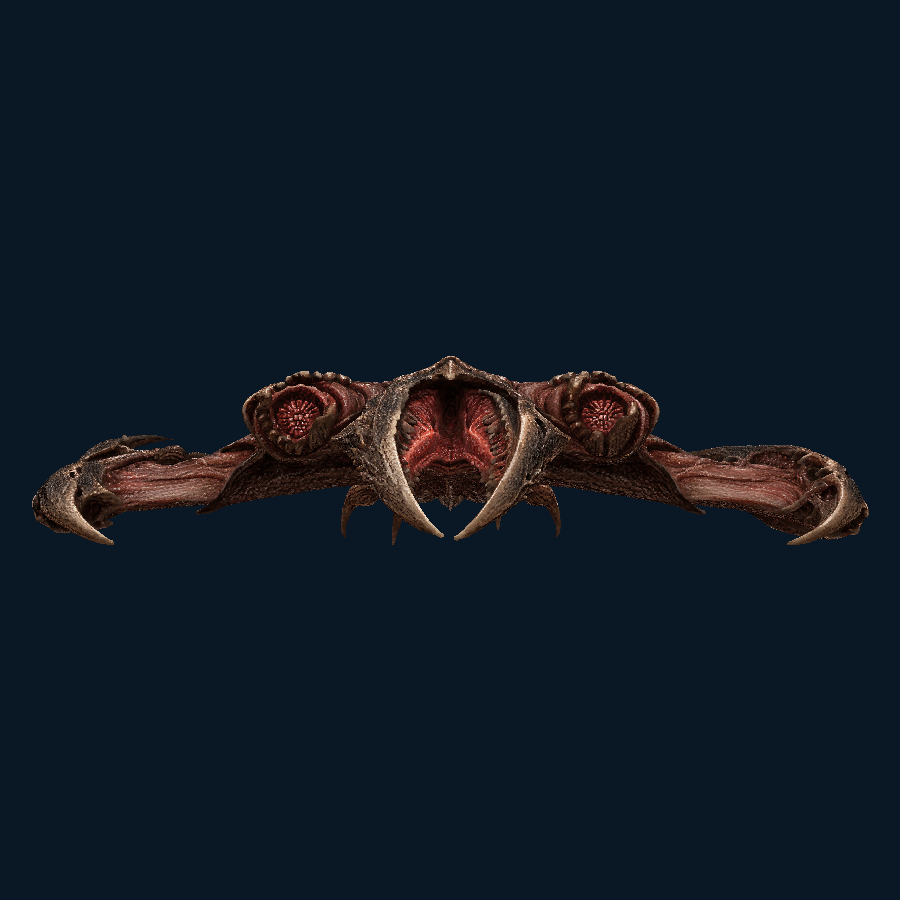
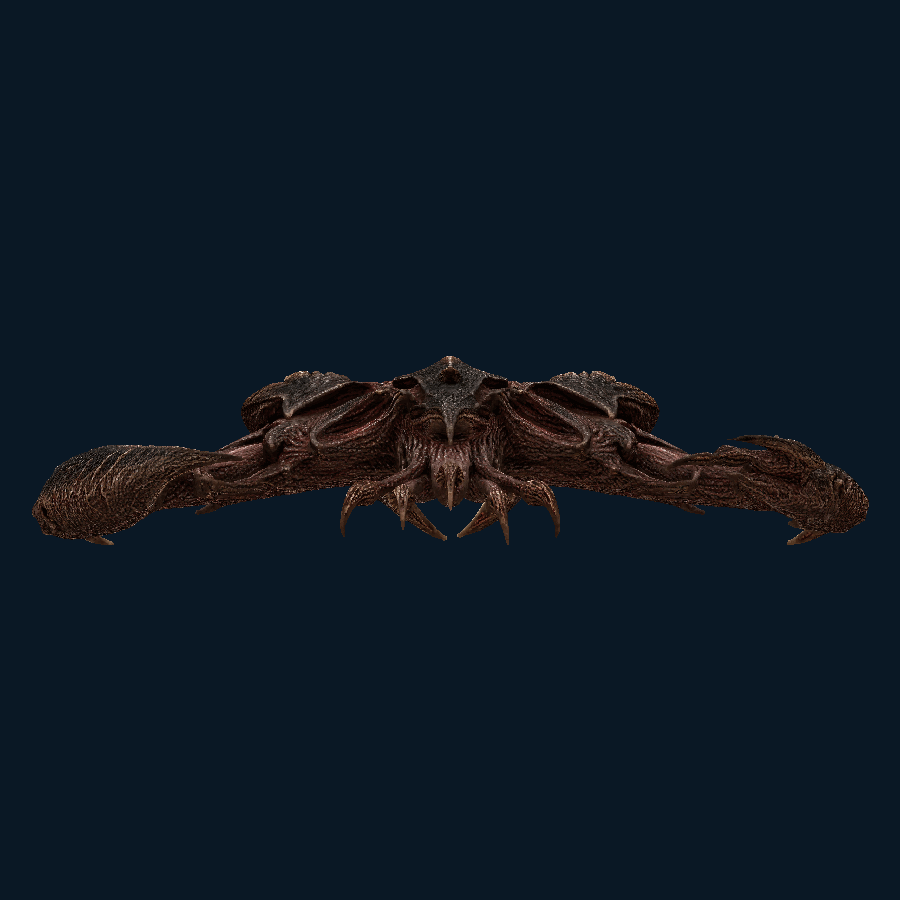
Length 67 m × Width 28 m × Height 9 m. Supplied fictional overall dimensions; height is the maximum body depth, including the depicted membrane and hardened-growth envelope.
Proposed living operating mass: approximately 3,000 ton (metric tons). This authored concept estimate allows for a flattened body, broad membranes, fluid-filled organs and local mineral reinforcement. It is not a measured mass or a claim of uniform density.
Weapons & Armament
The dominant attack system is one specialized symbiotic field-release organ. Its nutrient stomach, muscular pump, sensory nerve bundle, short living aperture and recovery sac form a continuous biological assembly. In the proposed combat interpretation, it concentrates a brief field disturbance toward a selected interception target; surrounding muscle absorbs the release and the recovery sac supports the next cycle. Exact range, yield and repetition rate are unspecified.
Two paired colonies of smaller defensive symbionts nest in vascular skin pockets, drawing nutrients through shared capillaries and responding through nerve tendrils. Hooked proboscises and short-range corrosive or electrically active secretions provide a proposed close-contact defense. Four irregular sensory-defender polyps monitor vulnerable soft regions. These are living defensive partners with limited reach, not independent mounted guns.
External Anatomy
A flattened connected body carries dark brown-black hardened growths over red-brown vascular tissue. Swept margins and broad elastic membranes establish a low interception profile, while a continuous sensory edge distributes awareness across the forward body. Hard regions grow from the epidermis into local reinforcement rather than enclosing the organism in a detachable hull.
The design assigns two muscular steering membranes and three broad ventral pulse membranes to control and braking. Thick tissue roots connect these surfaces to diagonal and longitudinal muscle sheets. Moist pockets around the main body shelter symbionts, and the quiet trailing tissue has no separate engine array.
Functional Architecture
Distributed cognition — A neural web beneath the sensory leading edge connects lateral ganglia and organ-level reflexes. Several hearts surround the center of mass, circulating blood and conductive gel through the working tissues. There is no cockpit, bridge or single exposed head.
Metabolism — Multiple digestive sacs process biomass and mineral feedstock. Fermentation symbionts convert nutrients into usable chemical and electrical reserves. Immune tissues, fat stores, reproductive organs and larval nurseries occupy overlapping internal zones rather than a sequence of ship decks.
Mineral assimilation — Specialized cells dissolve limited captured Cryvum material, transport ions through vessels and deposit a thin mineral-organic lattice in teeth, horn tips, weapon tissue and a few defensive glands. Isolation cysts contain unprocessed material. This is local biological assimilation, not Cryvum faction membership or attached metal armor.
Recovery — Circulation redistributes heat and nutrients after intense exertion. Damaged membranes require rest and feeding to repair; regeneration is finite and cannot erase major combat damage immediately.
Technical Specifications
Offensive rating: 64/100 — One dominant living attack organ creates focused interception opportunities
Defensive rating: 39/100 — Local hardened growths and defensive symbionts leave broad soft tissues vulnerable
Mobility rating: 91/100 — Whole-body field coupling and pulse membranes prioritize rapid control
Tactical cognition rating: 73/100 — Distributed sensory tissue and lateral ganglia coordinate pursuit and evasion
Endurance rating: 48/100 — Repeated maneuvering and attack require feeding and recovery
Fleet support rating: 35/100 — Interception protects nearby formations but provides little logistical support
Battlefield Role
Intercepts fast threats approaching a brood formation and exploits brief gaps along contested field boundaries. The low body depth, sensory emphasis and high control authority favor rapid engagement and disengagement. It contributes a focused attack window rather than prolonged heavy bombardment or fleet logistics.
Life Between Stars
A distributed peristaltic field system moves the entire organism. Traveling contractions pass through deep longitudinal muscles while vascular conductive gel couples to the surrounding fictional field. Broad ventral membranes provide braking and turning, assisted by the lateral steering tissues. Propulsion is spread across the body rather than concentrated at the tail.
Field-skimming describes movement relative to suitable local field gradients in the setting; it does not mean walking on water or atmospheric flight. The record establishes vacuum operations only. No independent phase-jump capability or unrestricted interstellar travel is assigned.
Defense Architecture
Localized hardened growths shield important tissue roots while flexible surfaces absorb deformation during maneuver. Sensory-defender polyps provide short-range warning and the smaller symbionts discourage close attackers. Limited mineralized defensive glands support a proposed localized field response. The main defense remains early detection and evasive movement, not battleship-scale armor.
Operational Limits
Thin steering and pulse tissues are vulnerable to sustained damage. Repeated attack releases and high-intensity maneuvers deplete nutrient reserves and require metabolic recovery. Its close defensive organisms cannot cover a large volume of space, and concentrated fire can overwhelm local reinforcement. Performance depends on suitable field interaction; it cannot replace a heavily protected line combatant or long-endurance carrier.
Strategic Strengths
Whole-body control supports rapid changes of orientation without relying on one exposed propulsion cluster. Distributed sensing maintains awareness along the leading edge, while a single dominant attack organ concentrates the interception role. Shared circulation coordinates host and symbionts and supports repair between engagements.
Capability Assessment
Proposed fictional doctrine profile. Mobility and tactical cognition are the strongest axes, reflecting distributed control and sensory coverage. Moderate attack and limited protection preserve the interceptor role. Endurance is constrained by metabolic recovery, and fleet support is low because the organism carries neither fleet workshops nor major transport capacity. Scores describe intended game roles rather than measured performance.
C · 58.3
Fleet-wide concept rating, 0–100; not simulated performance. Specialized strengths do not imply an equally high overall grade. Tactical Cognition describes sensing, coordination and command. Grade is the equal-weight mean: S ≥ 90, A ≥ 75, B ≥ 60, C ≥ 45, D < 45.
Technology Level
T1 — local space-capable biological field locomotion and distributed neural control. Independent phase travel is not established for this organism.
Weapon Class
Proposed W1 — focused interceptor attack with close biological defense. The design does not claim strategic theater or heavy fleet bombardment capability.
T0 planetary · T1 system flight · T2 phase travel · T3 limited world engineering. W0 point defense · W1 ship combat · W2 heavy fleet combat · W3 strategic theater systems. Technology and weapon classes are independent of the profile grade.
History & Lineage
Universe lore · authored service history
Origin
Grown within the fictional Bugvex void broods as a compact response organism for protecting mobile formations. Human observers assigned the Night Crown-class designation to its swept hardened margins and interception behavior; this reporting name is not an inscription on the living body.
Lineage & Branch
Bugvex Void Warforms — field-skimming interceptor lineage. Shared biological principles include distributed propulsion, symbiotic defense and selective mineral assimilation. The lineage organizes anatomy around vacuum interception rather than reproducing an enlarged terrestrial animal.
Brood or Swarm
Bugvex — fictional Veilwake brood interception screens, operating alongside larger void organisms
Individual History
The Veilwake Crossing — In this authored service history, Night Crown organisms screen a brood formation as it traverses a contested field corridor. Their forward sensory networks identify approaching scouts and redirect several interceptors toward a narrow engagement window. Heavy brood organisms retain the center while the smaller forms disrupt the approach and withdraw before prolonged fire can concentrate.
The Quiet Recovery — After repeated maneuvers, damaged interceptors return to the brood support zone for feeding and tissue repair. The loss of membrane strength forces a pause in operations despite the survival of their major attack organs. Subsequent doctrine rotates fresh organisms through the screen and reserves exhausted individuals for recovery rather than treating mobility as an unlimited resource.