
Overview
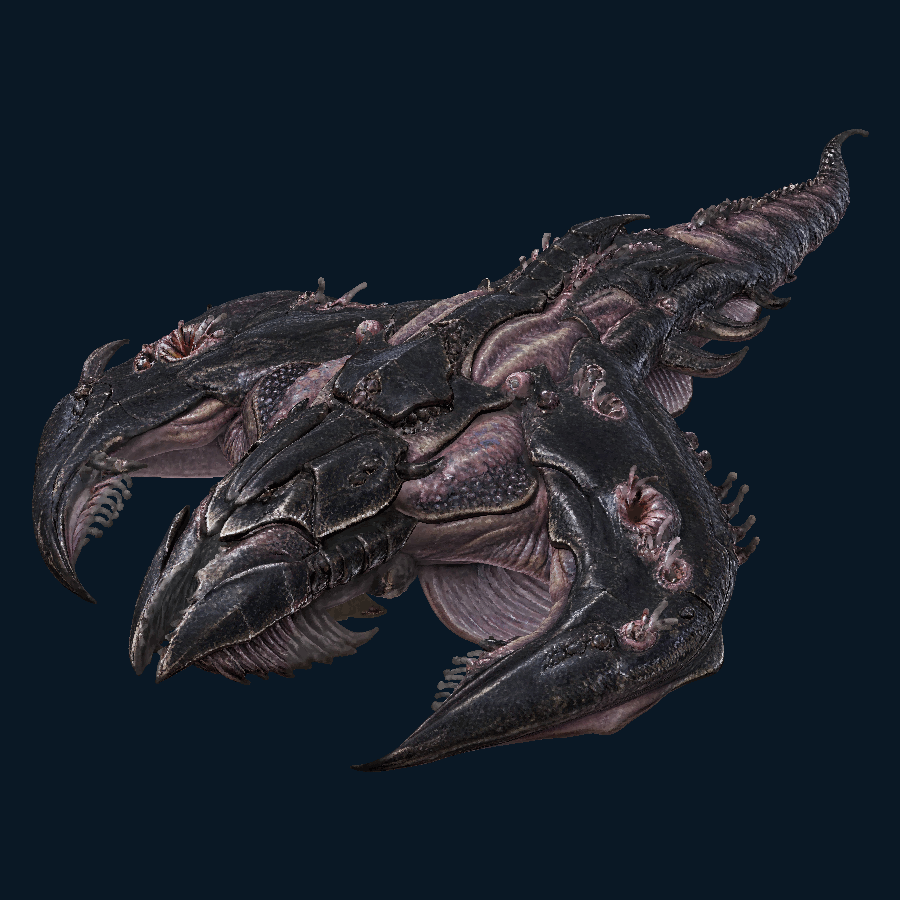
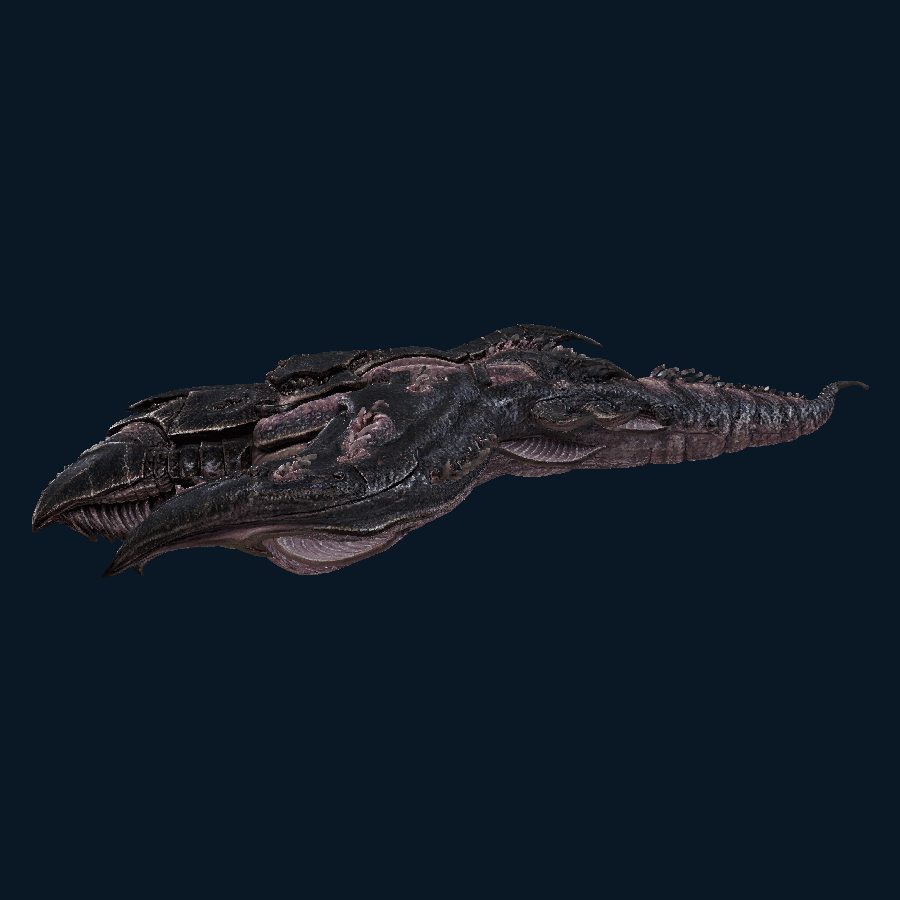
Ebon Seeker-class Battleship is a monumental Bugvex void organism that closes around fortified targets and crushes structural seams with its whole living body. Heavy dermal shields grow from vascular muscle beds, while distributed pulse membranes move the organism without a separate engine section.
Organism Profile
Dimensions & Scale
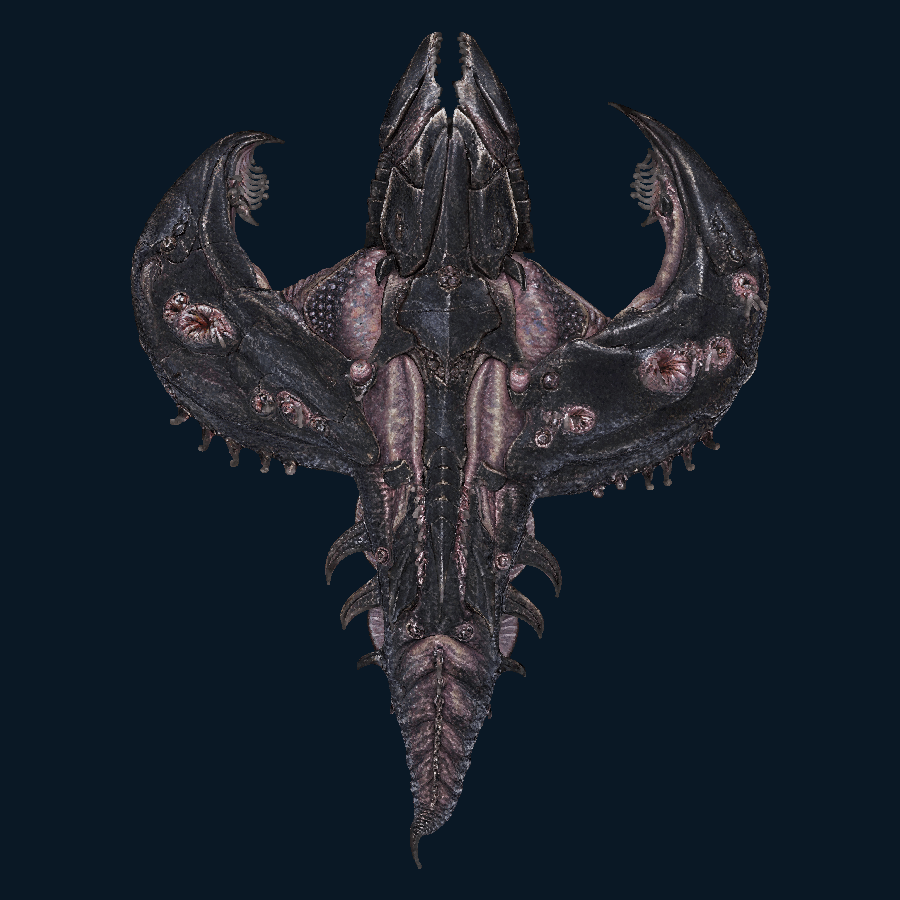
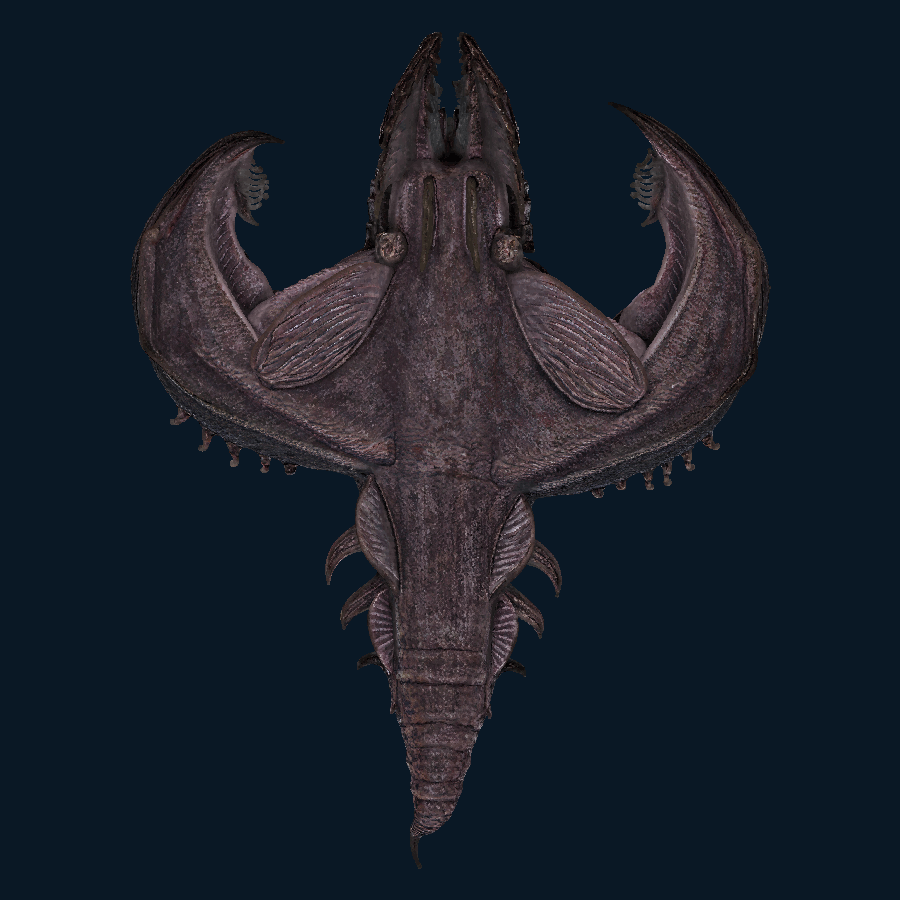
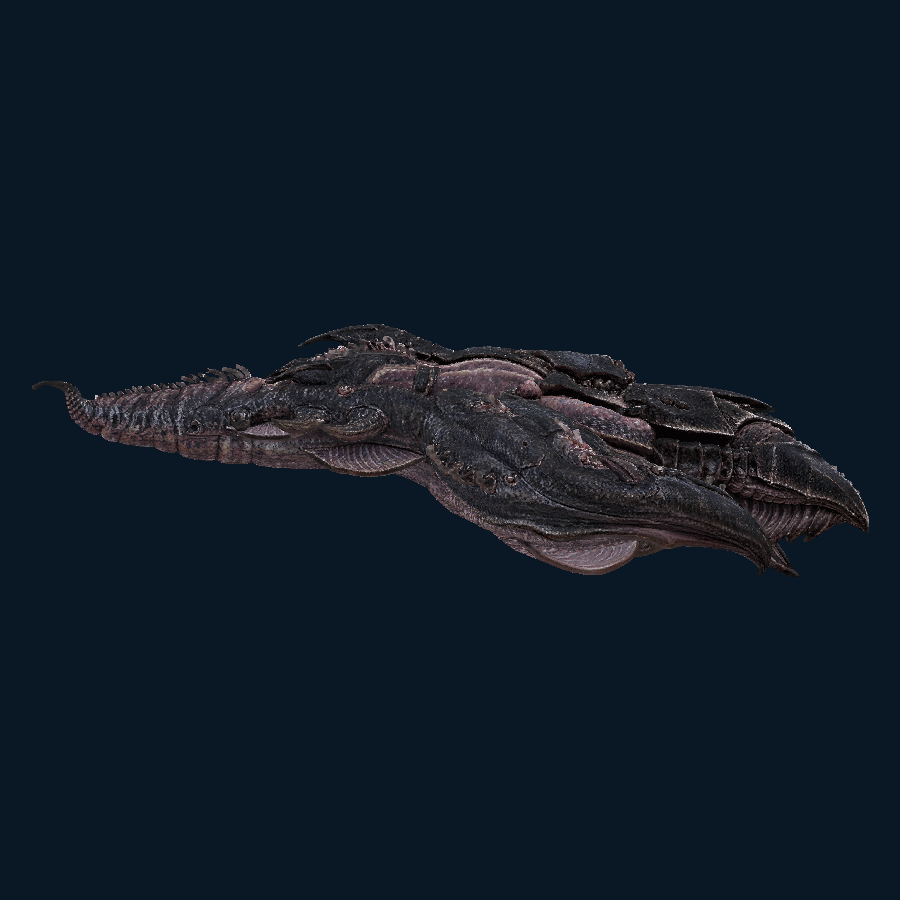
Length 1940 m × Width 1125 m × Height 543 m. Dimensions follow the supplied concept specification.
Proposed living operational mass: approximately 240,000,000 ton (metric tons). Fictional estimate based on size, anatomy and operating environment; not measured performance.
Weapons & Armament
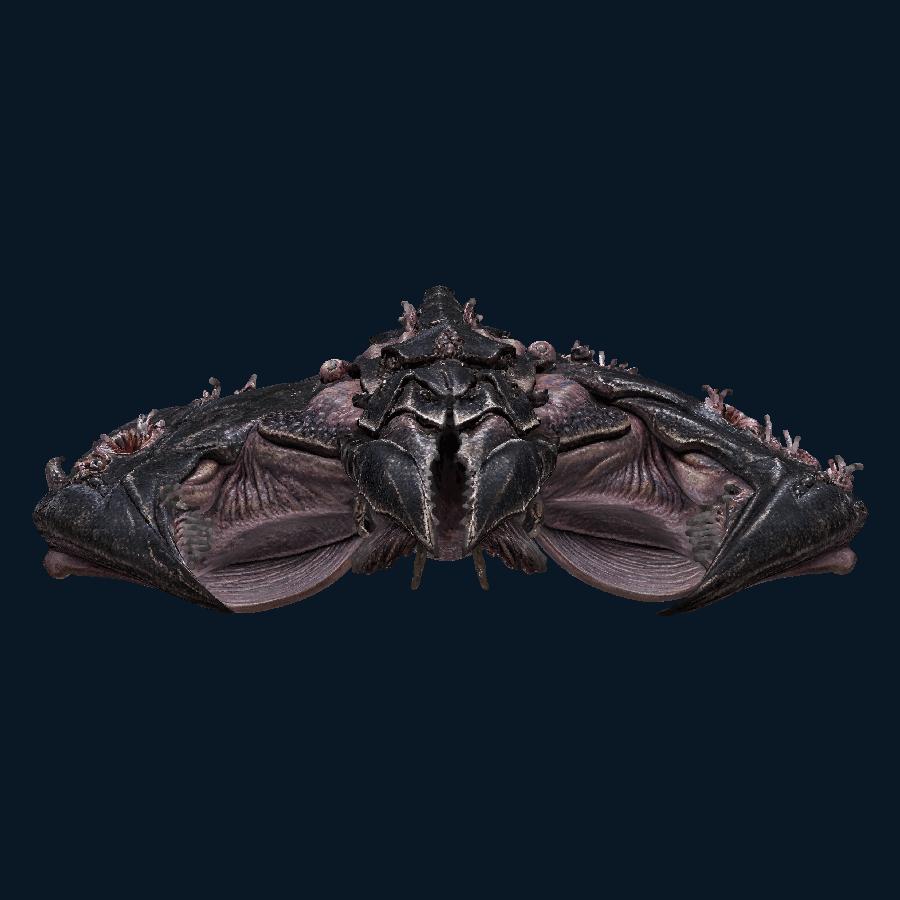
The primary weapon is a seam-crushing ram formed by the collision brow and interlocking dermal shields. Cryvum-mineralized enamel strengthens its contact surfaces. Eight paired colonies of defensive symbionts inhabit vascular pockets, supported by 24 irregular sensory-defender polyps. Their secretions, hooked feeding organs and sacrificial offspring provide close protection; all armament belongs to living anatomy.
External Anatomy
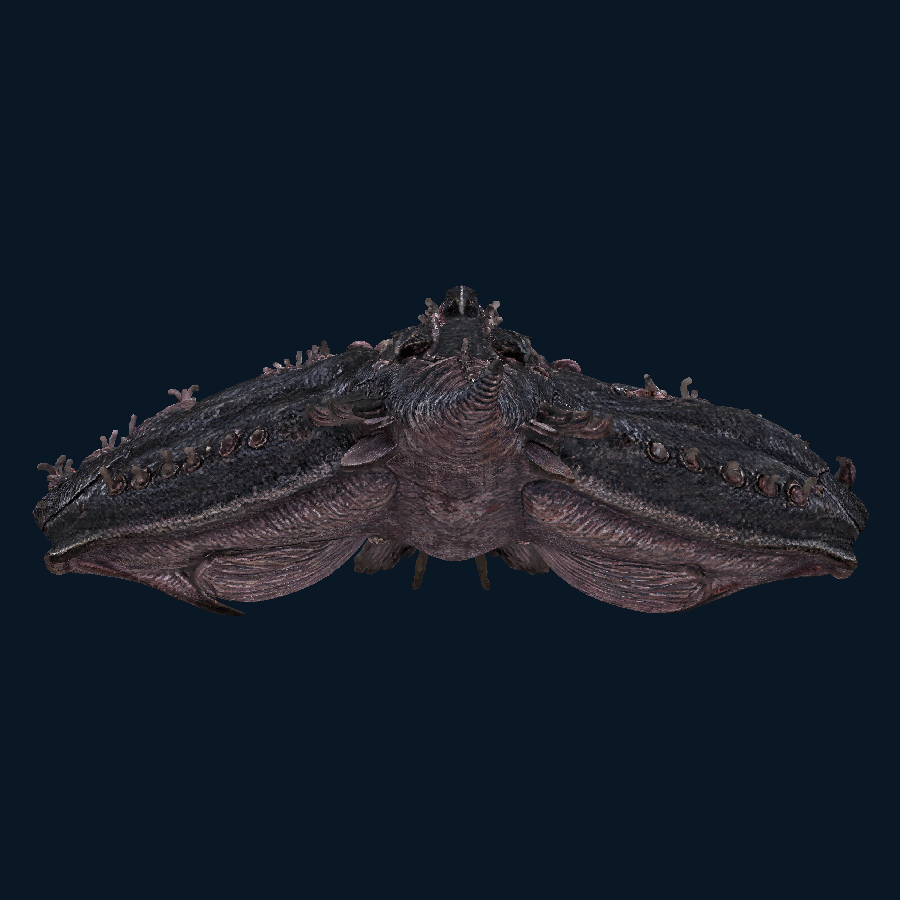
A thick central mass joins two muscular shoulder lobes and a tapered pressure tail. Glossy black shields cover local load-bearing tissue, with broad regions of exposed skin, muscle and joint membrane between them. Mineralized contact edges transfer collision loads into cartilage arches, fiber bundles and redundant hydrostatic supports.
Functional Architecture
A neural web follows the sensory leading edge and connects lateral ganglia. Several hearts circulate blood and conductive gel through overlapping digestive, immune and nursery regions. Specialized cells isolate assimilated Cryvum minerals and deposit thin reinforcing lattices in contact organs. Metabolic reserves support prolonged approach and tissue repair.
Technical Specifications
Offensive rating: 88/100 — The primary weapon is a seam-crushing ram formed by the collision brow and interlocking dermal shields
Defensive rating: 86/100 — Local shields deflect impacts while muscle sheets and hydrostatic zones spread loads
Mobility rating: 32/100 — Traveling muscular contractions couple conductive vascular gel to a fictional distributed propulsion field
Tactical cognition rating: 73/100 — A neural web follows the sensory leading edge and connects lateral ganglia
Endurance rating: 79/100 — Its enormous inertia makes a missed approach costly
Fleet support rating: 62/100 — Concentrated contact force, redundant living systems and localized mineral reinforcement make it a durable formation anchor
Battlefield Role
Pincer fortress and close-assault battleship. Ebon Seeker-class Battleship is a monumental Bugvex void organism that closes around fortified targets and crushes structural seams with its whole living body. Heavy dermal shields grow from vascular muscle beds, while distributed pulse membranes move the organism without a separate engine section.
Life Between Stars
Traveling muscular contractions couple conductive vascular gel to a fictional distributed propulsion field. Three broad ventral pulse membranes control braking and turning. The entire body participates in movement; the tail remains tissue. Vacuum operation is intrinsic to the design, but independent phase transit is not specified.
Defense Architecture
Local shields deflect impacts while muscle sheets and hydrostatic zones spread loads. Redundant hearts, distributed nerves and isolated mineral-processing cysts limit single-point failures. Symbiotic defenders guard exposed tissue during close approach.
Operational Limits
Its enormous inertia makes a missed approach costly. The dominant ram requires intimate contact, exposing softer seams to concentrated fire. Digestion, heat rejection and replacement tissue constrain repeated attacks; mineral assimilation cannot instantly rebuild lost anatomy.
Strategic Strengths
Concentrated contact force, redundant living systems and localized mineral reinforcement make it a durable formation anchor. Distributed propulsion permits gradual reorientation without presenting a single exposed drive cluster.
Capability Assessment
Proposed fictional doctrine profile: Concentrated contact force, redundant living systems and localized mineral reinforcement make it a durable formation anchor. Distributed propulsion permits gradual reorientation without presenting a single exposed drive cluster. Ratings describe intended battlefield roles rather than measured performance.
B · 70.0
Fleet-wide concept rating, 0–100; not simulated performance. Specialized strengths do not imply an equally high overall grade. Tactical Cognition describes sensing, coordination and command. Grade is the equal-weight mean: S ≥ 90, A ≥ 75, B ≥ 60, C ≥ 45, D < 45.
Technology Level
T1 — biological void operation and distributed fictional field propulsion; independent phase travel is unspecified
Weapon Class
Proposed W2 — capital-scale close assault and fortress breaching
T0 planetary · T1 system flight · T2 phase travel · T3 limited world engineering. W0 point defense · W1 ship combat · W2 heavy fleet combat · W3 strategic theater systems. Technology and weapon classes are independent of the profile grade.
History & Lineage
Universe lore · authored service history
Origin
Grown for void engagements in which a fortified target must be physically displaced or broken open. Human observers record it as a battleship; the pincer-fortress description identifies its combat function rather than a second hull class.
Lineage & Branch
Ebon Seeker void-fortress lineage, combining compression organs, dermal shields and distributed field locomotion
Brood or Swarm
Bugvex — Void Warforms
Individual History
The Black Convergence — In this authored account, an Ebon Seeker approaches a fortified orbital transfer node behind a screen of smaller organisms. Its neural web follows changes in the defenders’ firing rhythm and delays the final advance until the screen opens a narrow approach.
The Closed Seam — The battleship presses its reinforced brow into an outer docking brace and folds its shoulder lobes inward. After the brace yields, it withdraws slowly while its symbionts protect the damaged contact tissue. The encounter becomes an example of patient positioning rather than a high-speed charge.