
Overview
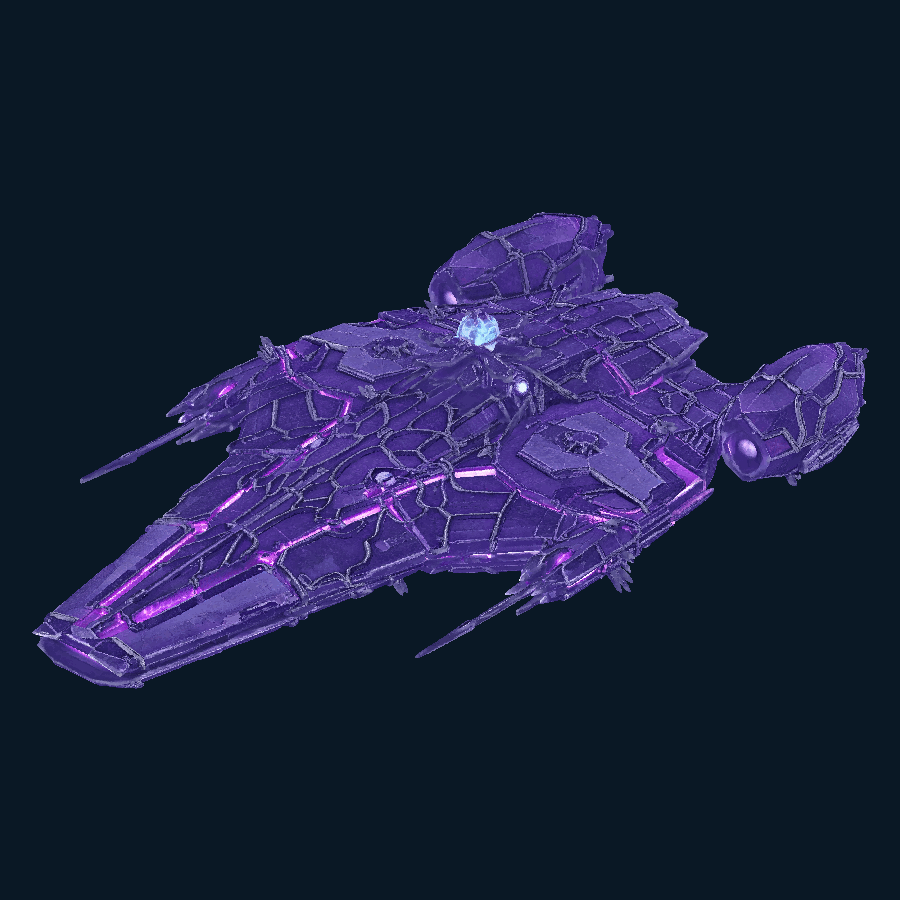
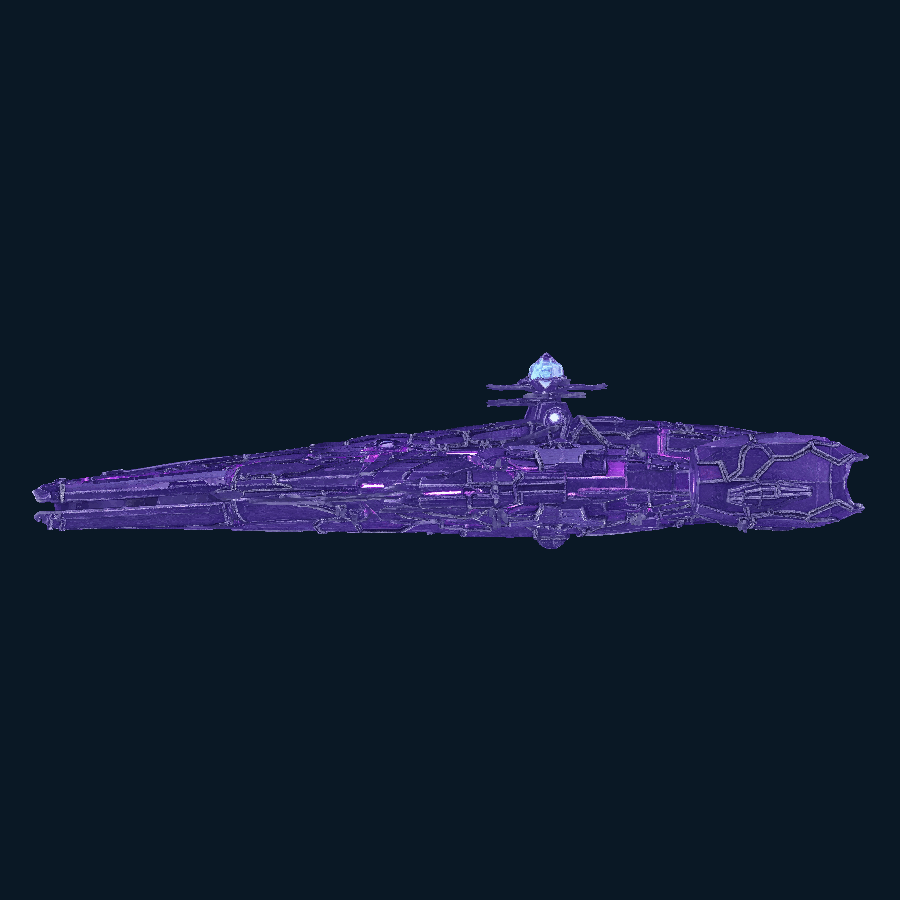
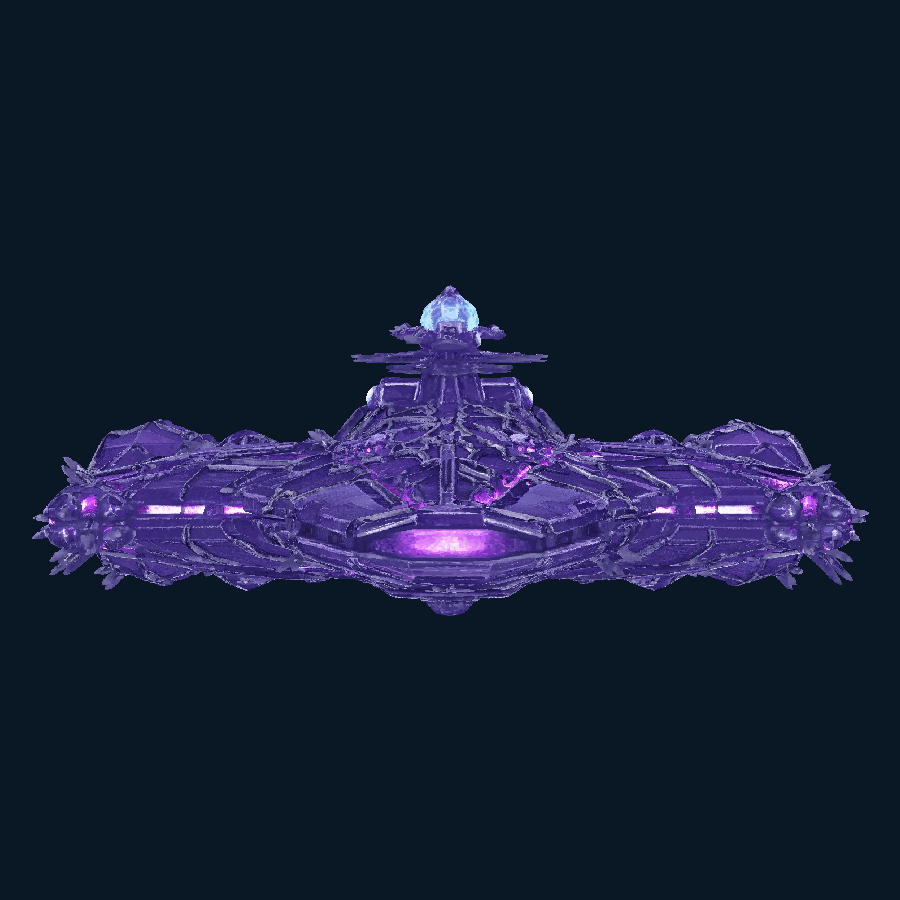
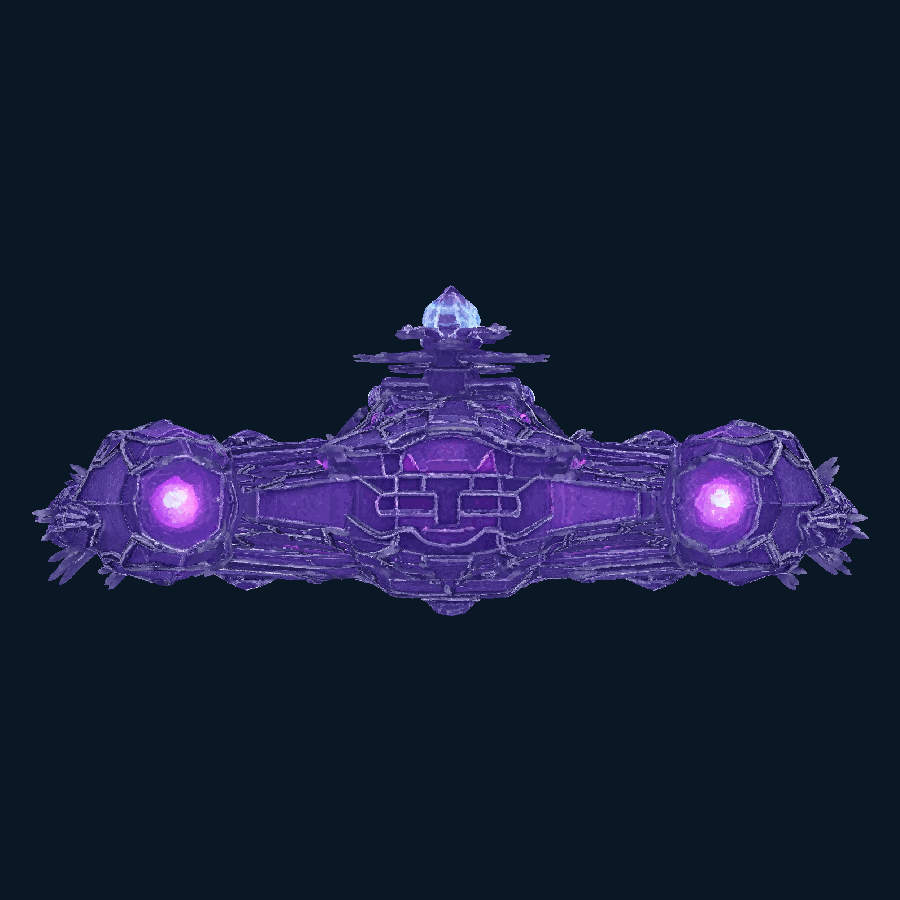
Violetcell is a continuous crystal-metal cruiser whose deep central mass supports forward attack domains and distributed protective fields
Vessel Profile
Weapons & Armament
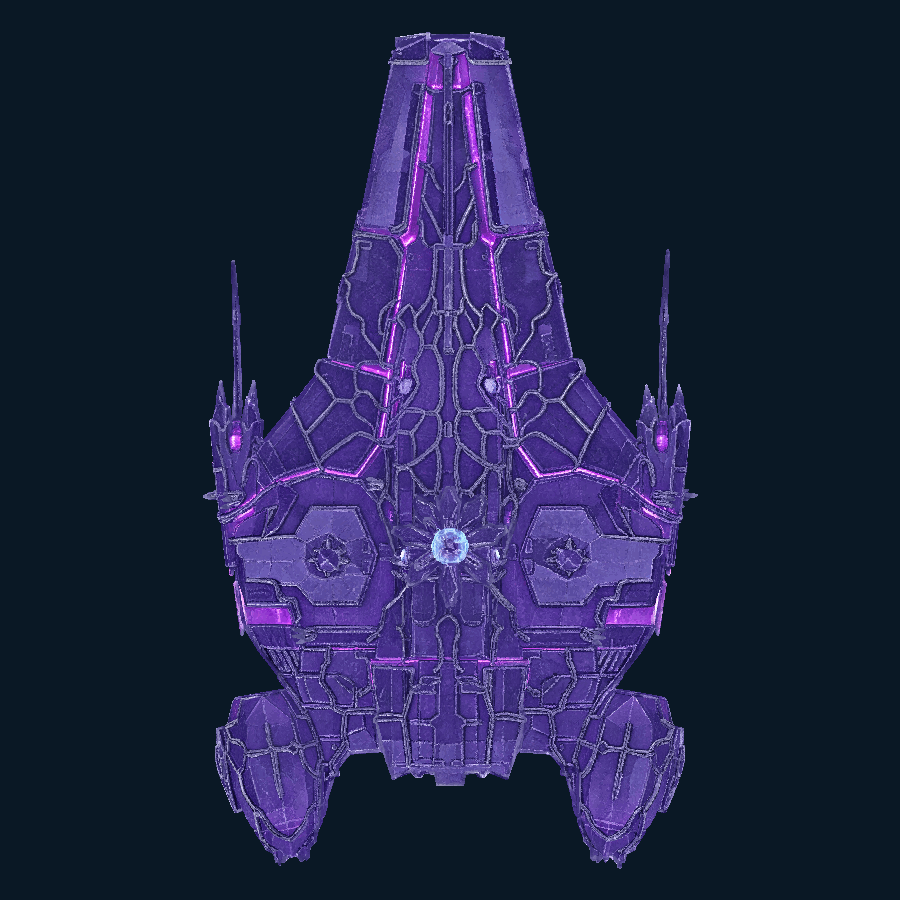
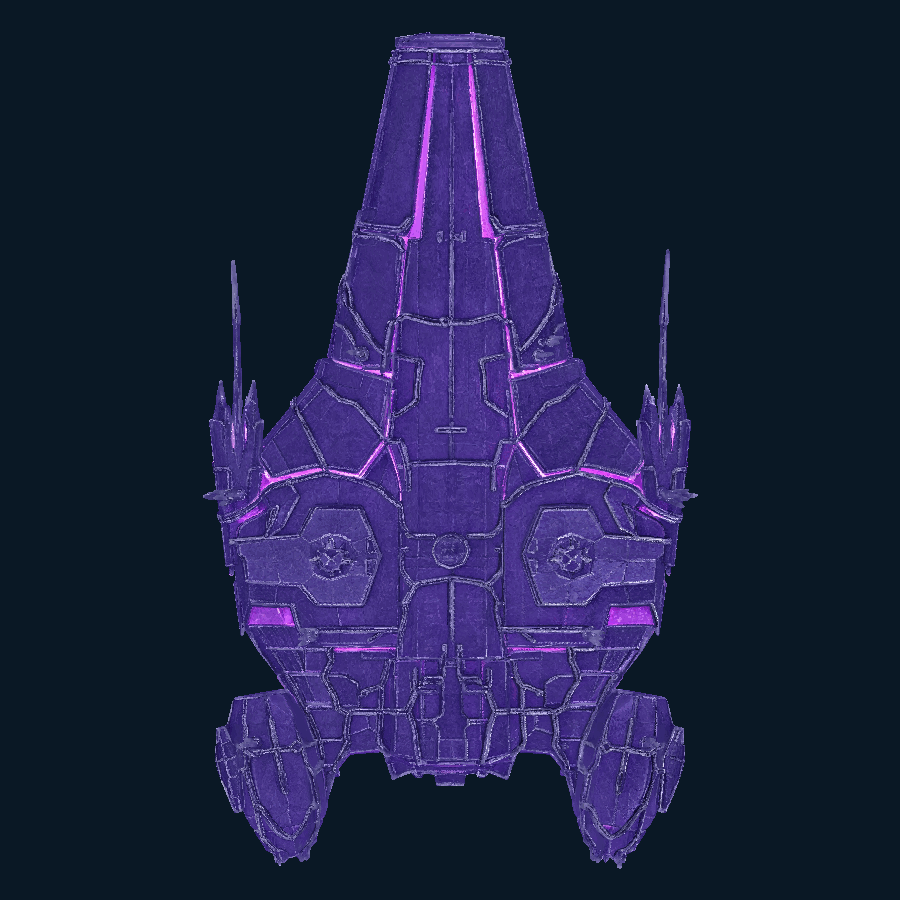
Forward-grown crystal formations gather energy through the lattice and concentrate it along attack channels. Some focusing structures resemble barrels, but they grow from the same crystal-metal body rather than being mounted equipment. Smaller side growths support secondary attacks and defensive fields.
Dimensions & Scale
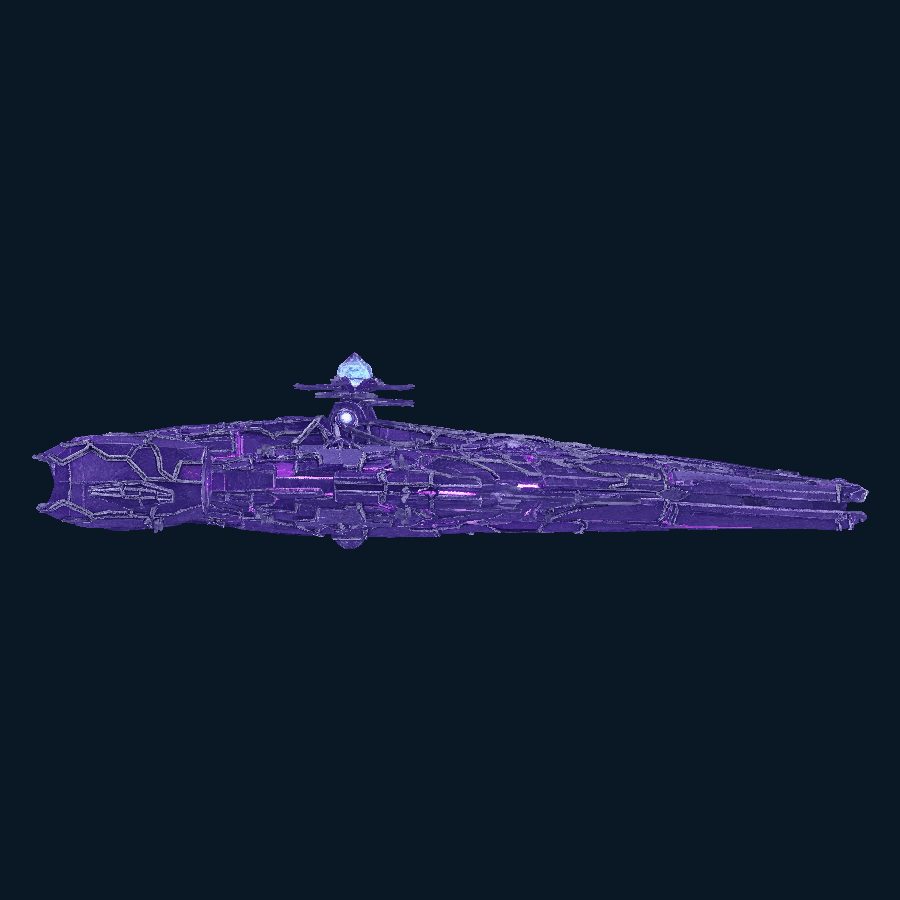
Length 900 m × Width 428 m × Height 217 m. Fictional overall dimensions in standard operating configuration.
External Anatomy
A deep central crystal mass joins the forward attack growths and broad rear support regions. All working domains share structural roots within one coherent body.
Functional Architecture
Energy transport, structural support and field coordination share connected crystalline domains and metal-rich paths. The proposed operating doctrine redistributes stored energy between the forward focus, protective side growths and rear propulsion regions instead of treating them as independent machines.
Technical Specifications
Offensive rating: 78/100 — Forward-grown crystal formations gather energy through the lattice and concentrate it along attack channels
Defensive rating: 67/100 — The deep central mass distributes incoming force through its continuous lattice
Mobility rating: 65/100 — Maneuvering supports the formation and mission profile rather than unrestricted pursuit
Tactical cognition rating: 76/100 — Target assessment, formation coordination and response timing support traverse-class cruiser operations
Endurance rating: 60/100 — Mission duration depends on finite reserves, damage recovery and scheduled replenishment
Fleet support rating: 38/100 — Operates as a balanced independent cruiser, supporting route patrols and convoy screening while retaining a concentrated forward attack
Fleet Role
Operates as a balanced independent cruiser, supporting route patrols and convoy screening while retaining a concentrated forward attack. It can reinforce a threatened sector without requiring a fortress-sized formation.
Life Between Stars
Rear formations change field pressure along their growth directions to produce motion and steering. No exhaust engine is required by the vessel. Operational doctrine favors controlled repositioning that preserves a coherent attack axis.
Defense Architecture
The deep central mass distributes incoming force through its continuous lattice. Side growths redirect stored energy into defensive fields, making protection an active function of the same material used for attack and movement.
Operational Limits
Editorial constraints: concentrated attack, protection and motion draw on shared reserves. Damage at a major growth root can affect several functions simultaneously. Regrowth requires compatible material and stable conditions; a cruiser cannot sustain fortress-level protection indefinitely.
Strategic Strengths
Balanced attack, protective depth and coordinated field control support independent service. Distributed side growths provide options beyond a single forward discharge without fragmenting the organism-like crystalline body.
Capability Assessment
Forward crystal focusing structures concentrate lattice energy along distinct attack channels, while side growths provide secondary pressure and defensive fields. Strong attack and sensing define this cruiser; sustained protection and support remain below fortress level.
B · 64.0
Fleet-wide concept rating, 0–100; not simulated performance. Specialized strengths do not imply an equally high overall grade. Tactical Cognition describes sensing, coordination and command. Grade is the equal-weight mean: S ≥ 90, A ≥ 75, B ≥ 60, C ≥ 45, D < 45.
Technology Level
Proposed T2 — integrated field motion and phase-compatible fleet operations, following the reference exhibit’s editorial classification. This is a setting proposal, not a measured transit specification.
Weapon Class
Proposed W2 — concentrated field engagement against fleet targets. No world-scale destructive capability is assigned.
T0 planetary · T1 system flight · T2 phase travel · T3 limited world engineering. W0 point defense · W1 ship combat · W2 heavy fleet combat · W3 strategic theater systems. Technology and weapon classes are independent of the profile grade.
History & Lineage
Universe lore · authored service history
Origin
Cultivated for routes where a self-contained cruiser must alternate reconnaissance, escort and direct combat without a permanent fortress nearby
Lineage & Branch
Fluorite-derived Traverse cruiser. Its mineral domains and metallic phases grow together as one connected body.
Fleet or Unit
Prism Passage Watch
Individual History
The Prism Crossing — Violetcell held a broken transit corridor while mineral transports changed their route. Its side fields absorbed scattered pressure while the forward growths remained quiet, conserving the reserve needed for the final crossing.
The Rejoined Seam — A damaged side root regrew with a paler boundary after that patrol. The Passage Watch kept the seam visible in its identification records, marking a repaired connection rather than a replacement component.