
Overview
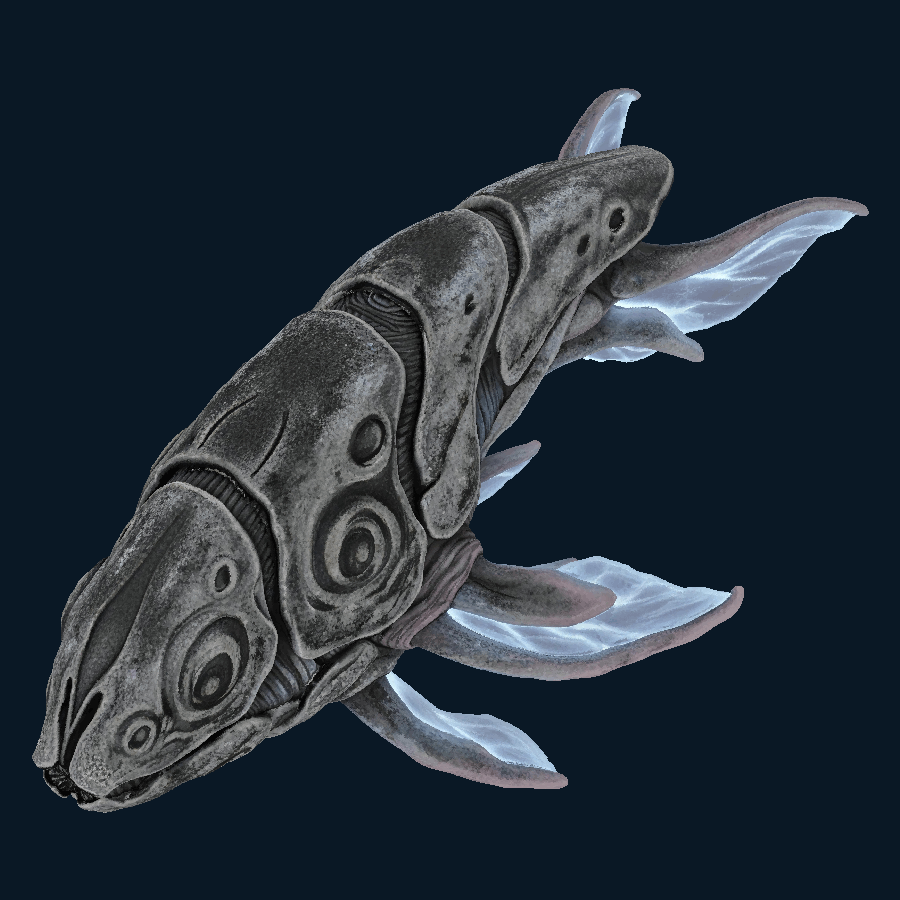
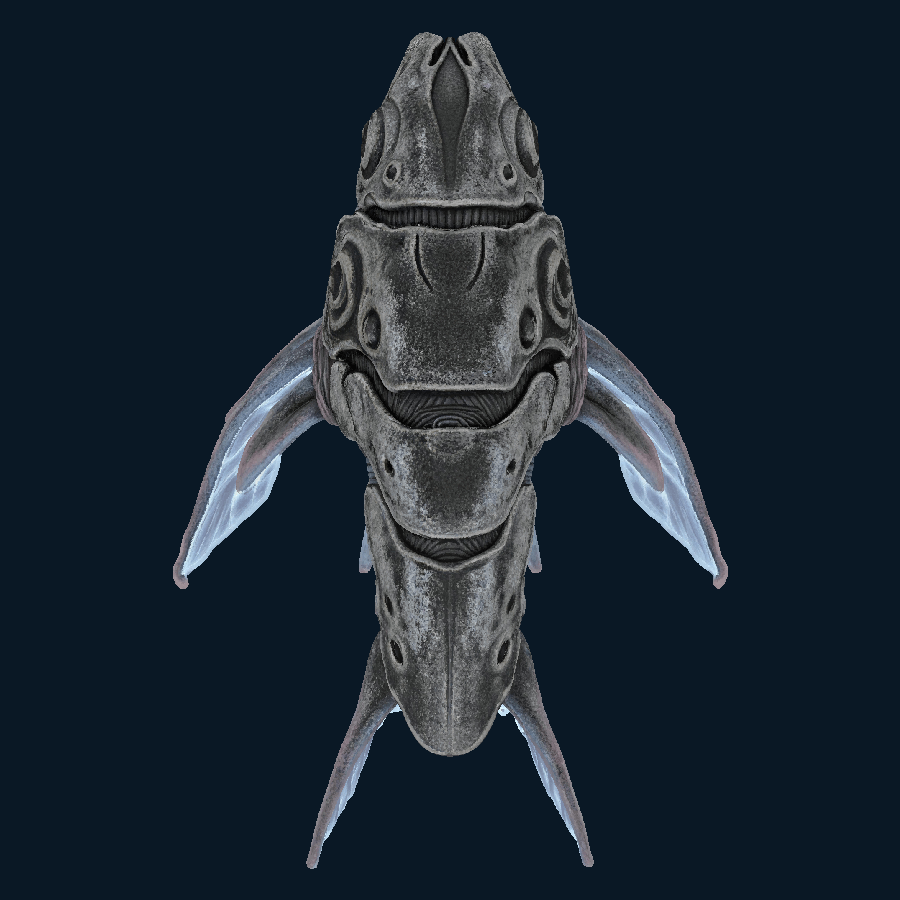
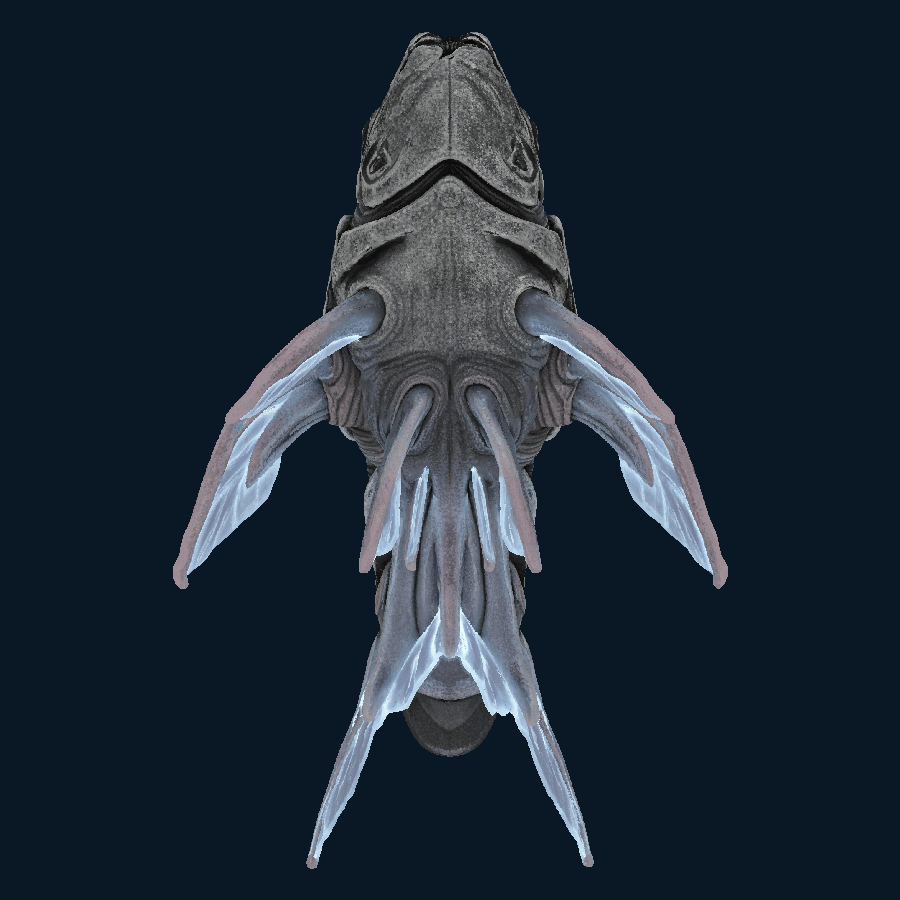
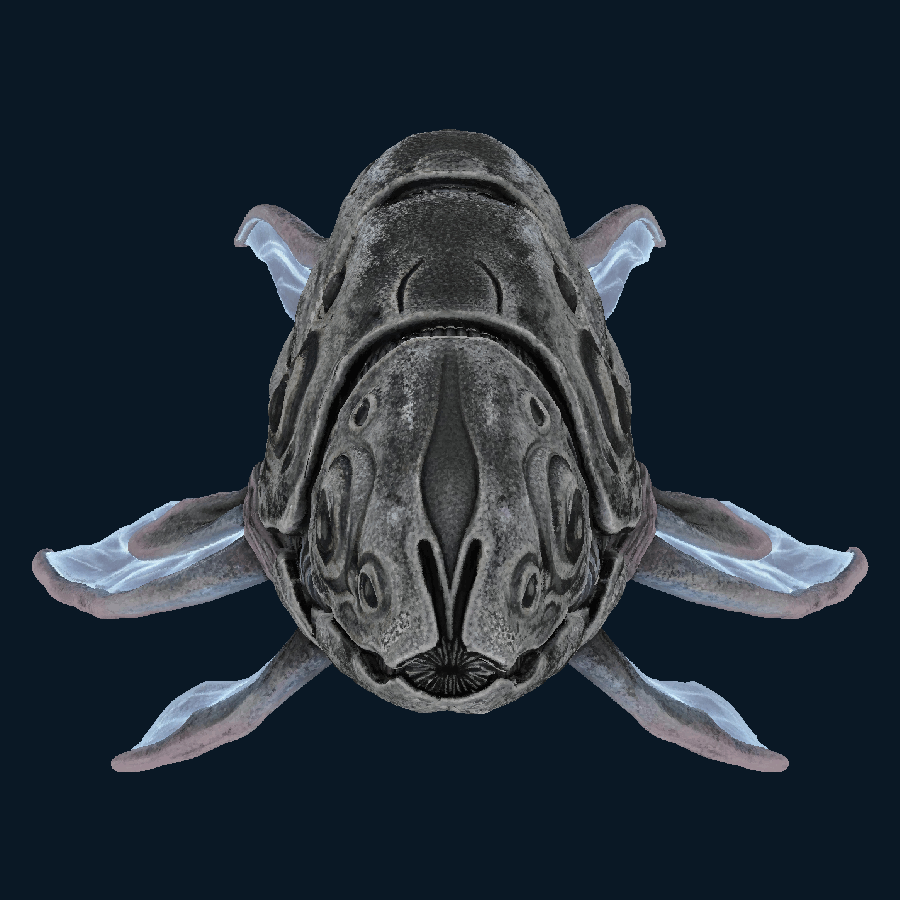
Ashen Sentinel has a compact crescent-seed body, a continuous sensory leading edge and two muscular steering membranes. Black-and-white mottling and large false eyespots are living tissue that helps draw hostile attention.
Vessel Profile


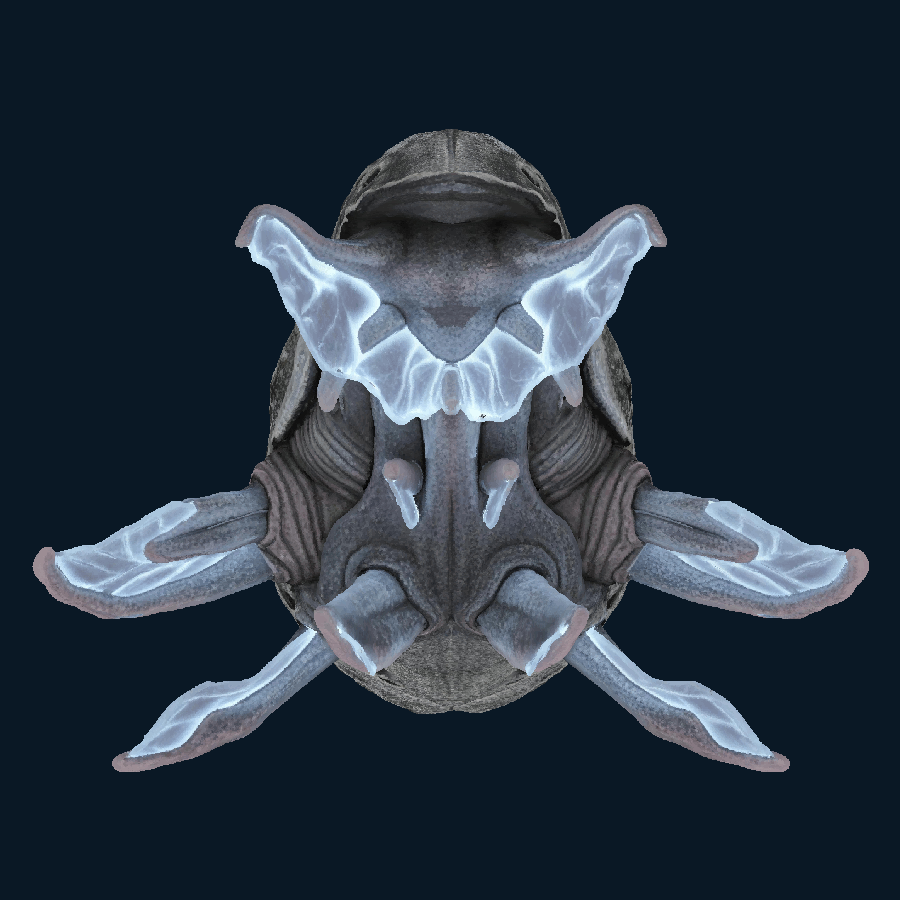
Weapons & Armament
A multi-band biological sensor crown and targeting-disruption pulse organ form its principal combat system. The false eyespots reinforce its decoy identity. Its purpose is to confuse an opponent’s targeting and draw attention away from the carrier, rather than defeat armored ships through direct damage.
Dimensions & Scale
Length 53 m × Width 22 m × Height 7 m. Fictional overall dimensions in standard operating configuration.
External Anatomy
A compact crescent-seed body carries a continuous sensory leading edge. Black-and-white mottling and large false eyespots belong to living tissue. Two muscular steering membranes extend from the body, coupling changes in posture to the organism’s movement.
Functional Architecture
Sensory tissue feeds coordinated responses between the leading edge, pulse organ and steering membranes. The proposed brood doctrine alternates active decoys with recovering members, so one exhausted organism does not have to sustain the entire screen.
Technical Specifications
Offensive rating: 15/100 — A multi-band biological sensor crown and targeting-disruption pulse organ form its principal combat system
Defensive rating: 18/100 — Misdirection, dispersed spacing and rapid movement provide most of its protection
Mobility rating: 82/100 — Maneuvering supports the formation and mission profile rather than unrestricted pursuit
Tactical cognition rating: 48/100 — Target assessment, formation coordination and response timing support decoy interceptor operations
Endurance rating: 25/100 — Mission duration depends on finite reserves, damage recovery and scheduled replenishment
Fleet support rating: 58/100 — Maintains a dispersed carrier screen, presents false priorities to hostile tracking and opens short windows for brood deployment
Fleet Role
Maintains a dispersed carrier screen, presents false priorities to hostile tracking and opens short windows for brood deployment. Gaps between the eight groups preserve room for motion and reduce the risk of one attack striking the whole screen.
Life Between Stars
The two muscular membranes coordinate attitude changes with the organism’s living propulsion system. Proposed movement uses short changes of direction and staggered group positions rather than a rigid ring. Endurance depends on periods of reduced pulse activity and metabolic recovery.
Defense Architecture
Misdirection, dispersed spacing and rapid movement provide most of its protection. The screen protects its carrier by making a reliable target solution harder to maintain. The organism is not assigned the armor depth of a cruiser or dreadnought.
Operational Limits
The pulse organ consumes blood flow, nutrients and body heat. Continuous disruption cannot be maintained indefinitely. A decoy that becomes predictable loses its main advantage, and light protection makes a successful hostile hit dangerous.
Strategic Strengths
High mobility, strong sensory coordination and useful disruption allow a relatively small organism to support a much larger carrier. The formation spreads this burden among several groups rather than concentrating it in one vulnerable body.
Capability Assessment
A light decoy organism with exceptional mobility but little direct firepower or protection. Its support value depends on nearby brood members; it cannot sustain a fleet engagement alone.
D · 41.0
Fleet-wide concept rating, 0–100; not simulated performance. Specialized strengths do not imply an equally high overall grade. Tactical Cognition describes sensing, coordination and command. Grade is the equal-weight mean: S ≥ 90, A ≥ 75, B ≥ 60, C ≥ 45, D < 45.
Technology Level
T1 — space-operating biological civilization. This editorial class describes the demonstrated space role; phase travel and world engineering are not assigned from anatomy alone.
Weapon Class
W0 — targeting disruption and defensive screening. The classification describes its assigned role, not a measured damage output.
T0 planetary · T1 system flight · T2 phase travel · T3 limited world engineering. W0 point defense · W1 ship combat · W2 heavy fleet combat · W3 strategic theater systems. Technology and weapon classes are independent of the profile grade.
History & Lineage
Universe lore · authored service history
Origin
Cultivated as a sensory and deception specialist to accompany mobile brood carriers through contested approaches
Lineage & Branch
decoy-interceptor branch. Its black-and-white mottling and false eyespots draw on the eyed click beetle reference, translated into a continuous vacuum-adapted organism.
Brood or Swarm
Pale-Eye Screen
Individual History
The Empty Target — A Pale-Eye quartet drew a pursuing battery away from a carrier’s birthing folds. The four organisms changed their pulse rhythm in sequence, keeping the false target ahead of the brood cloud.
The Quiet Fourth — One exhausted Sentinel stopped pulsing but remained within its group. The other three widened their spacing until it recovered. In this brood’s lore, a missing pulse means close the protective pattern rather than abandon its source.