Overview
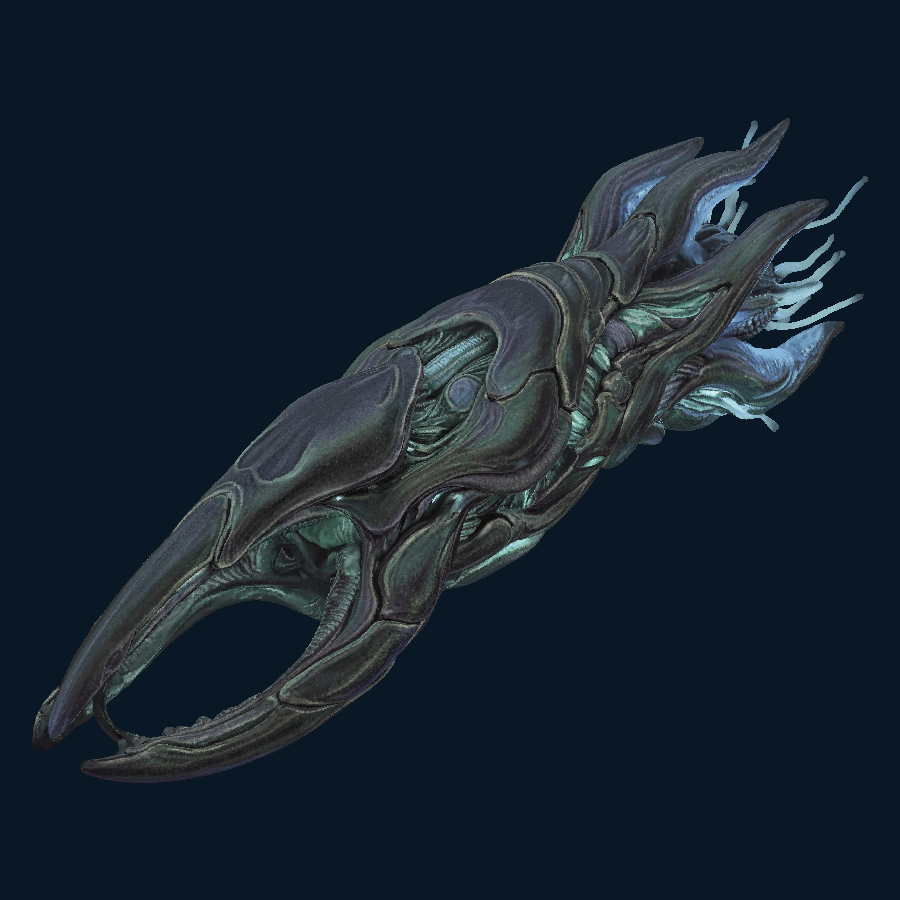
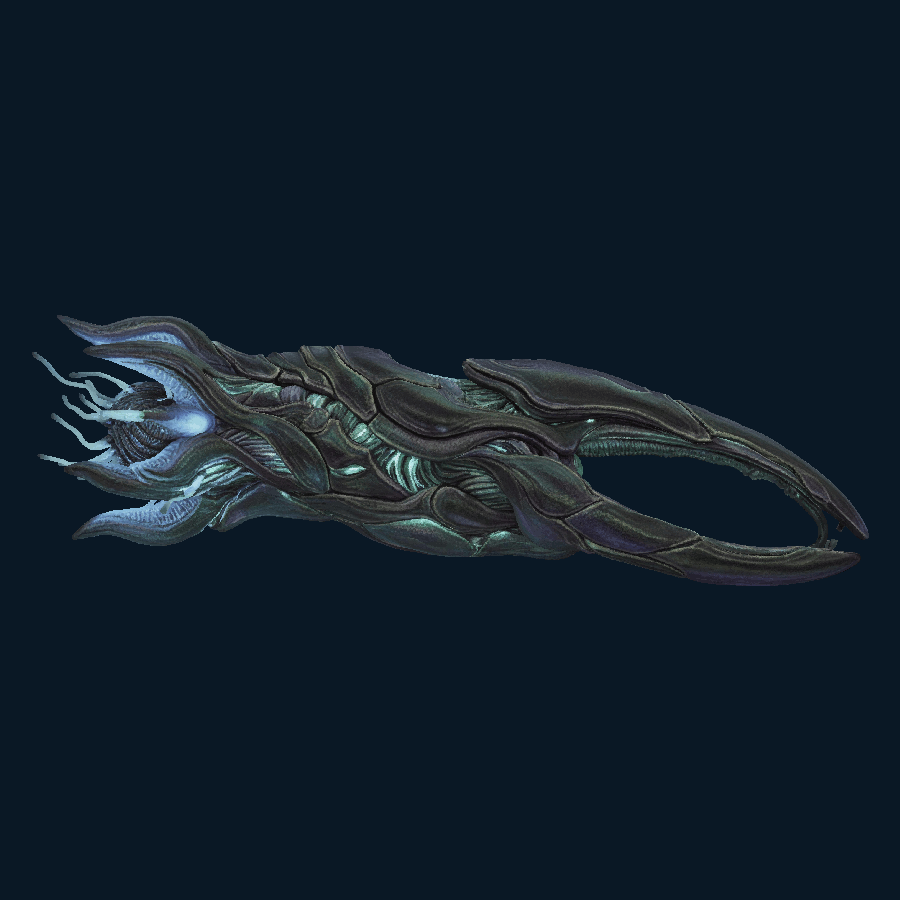
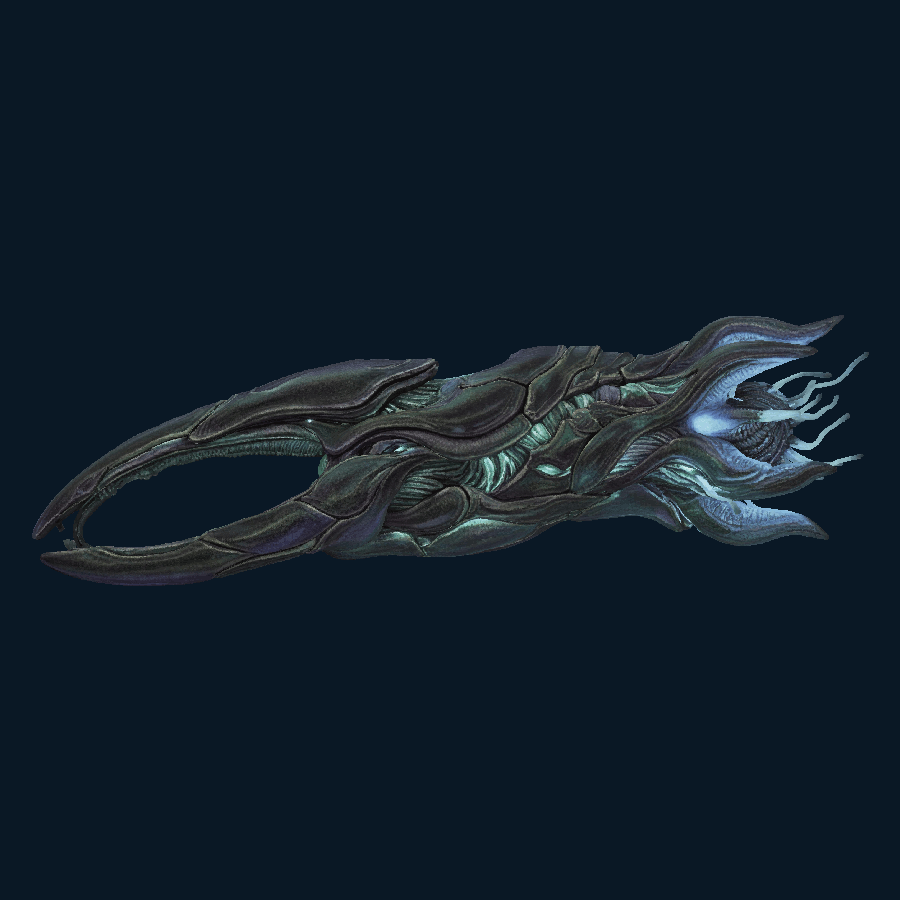
Obsidian Maw is a living capture frigate. A collision brow, dermal shields and integrated muscle groups support a powerful forward clamp reinforced by assimilated minerals.
Vessel Profile
Weapons & Armament
A swollen collision brow, interlocking dermal shields and whole-body muscle action provide the main capture attack. The organism closes on a target to crush, grip and restrain it. Assimilated Cryvum minerals reinforce selected tissue rather than turning the body into an assembled metal machine.
Dimensions & Scale
Length 425 m × Width 196 m × Height 94 m. Fictional overall dimensions in standard operating configuration.
External Anatomy
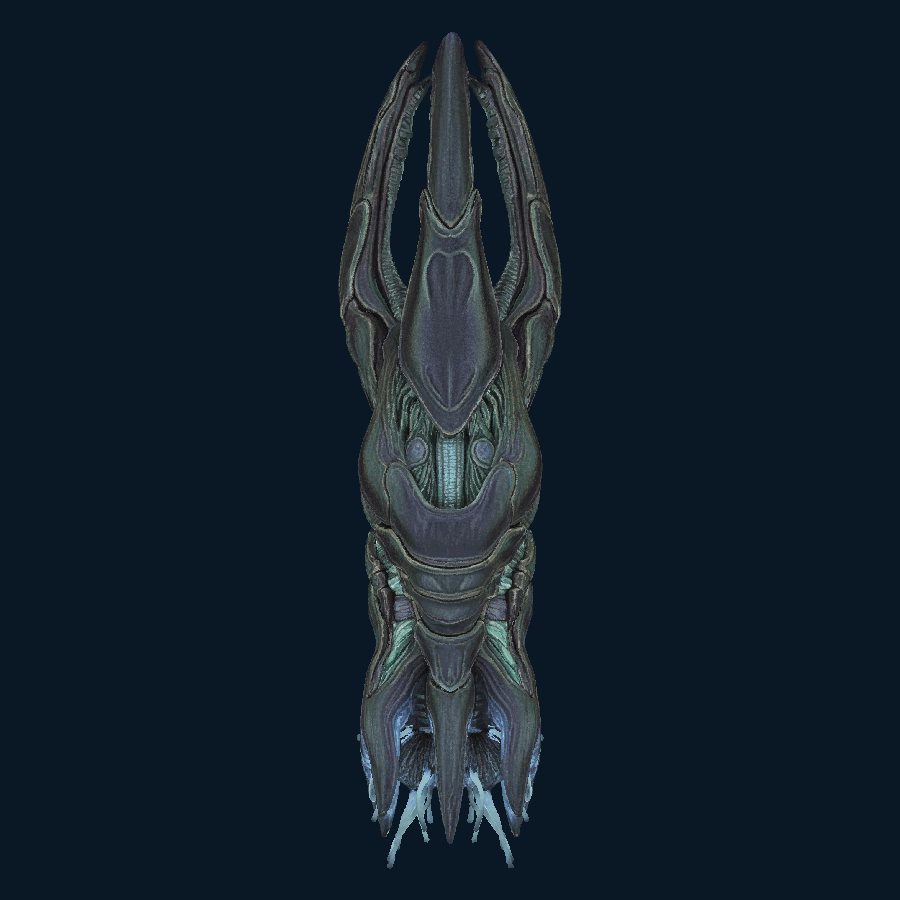
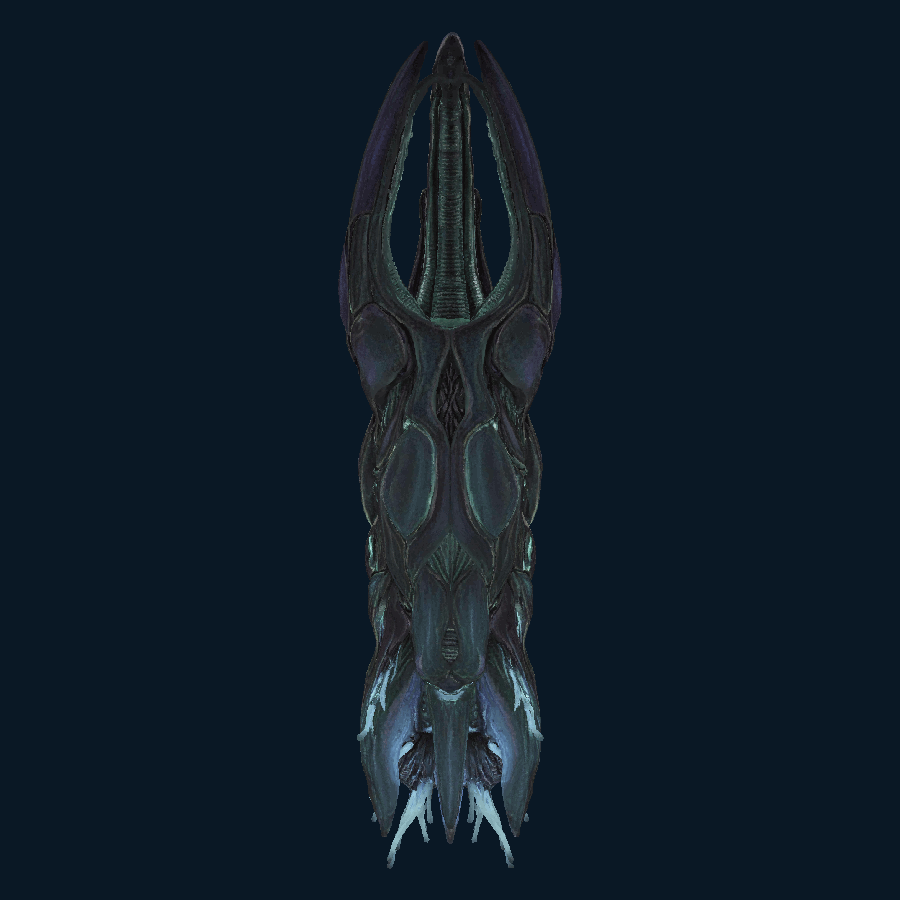
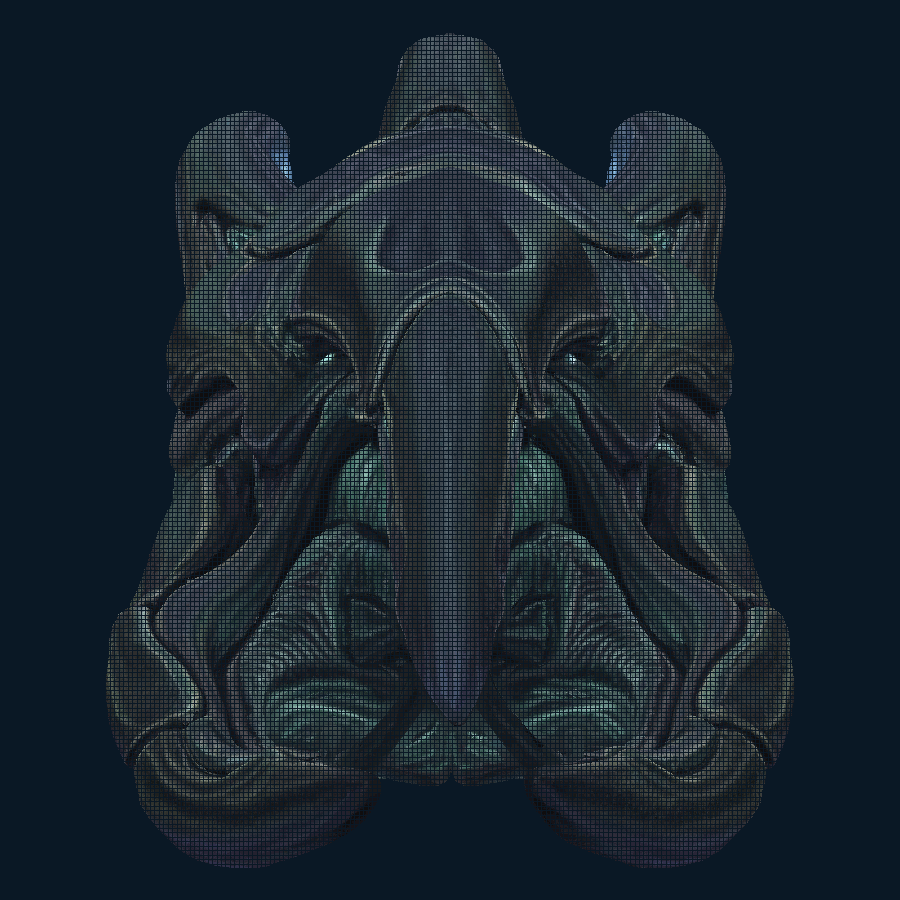
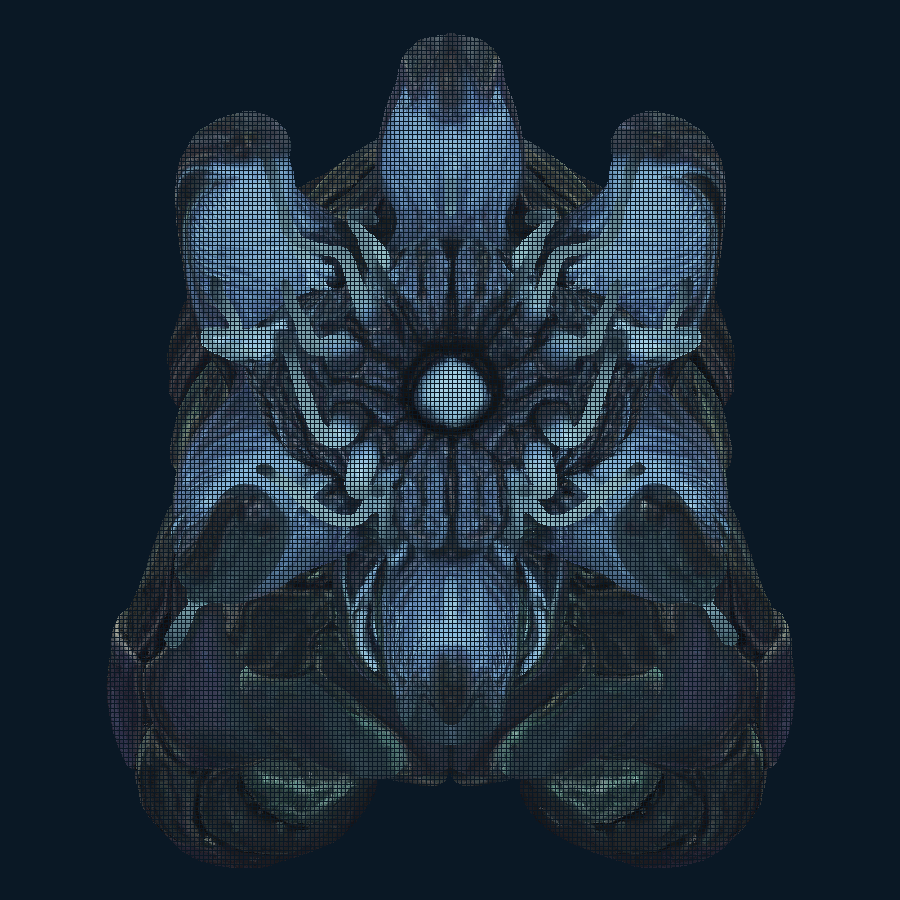
A smooth armored living body joins a long open clamping region. Three underside membranes and deeply connected capture muscles remain integrated with the main organism.
Functional Architecture
Muscle groups coordinate the entire body during capture. Eight symbionts in four pairs and twelve polyps support the host. The proposed circulation pattern alternates hard exertion with recovery, supplying the brow, clamp roots and steering tissues as the engagement changes.
Technical Specifications
Offensive rating: 74/100 — A swollen collision brow, interlocking dermal shields and whole-body muscle action provide the main capture attack
Defensive rating: 49/100 — Interlocking dermal shields and a swollen collision brow protect the contact region
Mobility rating: 76/100 — Maneuvering supports the formation and mission profile rather than unrestricted pursuit
Tactical cognition rating: 49/100 — Target assessment, formation coordination and response timing support capture frigate operations
Endurance rating: 39/100 — Mission duration depends on finite reserves, damage recovery and scheduled replenishment
Fleet support rating: 25/100 — Closes rapidly on an isolated or disrupted target and holds it for the brood
Fleet Role
Closes rapidly on an isolated or disrupted target and holds it for the brood. Toxin escorts can improve the approach, while boarding organisms exploit the restraint after contact is established.
Life Between Stars
Three underside membranes assist the organism’s control during approach and braking. Proposed movement spends its mobility advantage on reaching a useful grip rather than orbiting a target indefinitely.
Defense Architecture
Interlocking dermal shields and a swollen collision brow protect the contact region. Local symbionts guard exposed tissue, while mineral reinforcement strengthens selected surfaces. Remaining attached to a target can also restrict its ability to evade new threats.
Operational Limits
Contact attacks tear membranes and fatigue muscle. Repairs consume nutrients, and a lost grip may leave the organism exposed beside a stronger opponent. The Operational doctrine avoids solitary attacks against a target whose escorts remain free to maneuver.
Strategic Strengths
Good approach mobility and specialized capture anatomy let the frigate turn a brief opening into a sustained boarding opportunity. Its reinforced brow and coherent muscle structure support a focused mission rather than many unrelated weapon systems.
Capability Assessment
The elongated capture anatomy turns a rapid approach into a crushing grip. Strong contact attack and mobility make this a dangerous specialist, while limited endurance and fleet support prevent it from filling a capital-ship role.
C · 52.0
Fleet-wide concept rating, 0–100; not simulated performance. Specialized strengths do not imply an equally high overall grade. Tactical Cognition describes sensing, coordination and command. Grade is the equal-weight mean: S ≥ 90, A ≥ 75, B ≥ 60, C ≥ 45, D < 45.
Technology Level
T1 — space-operating biological civilization. This editorial class describes the demonstrated space role; phase travel and world engineering are not assigned from anatomy alone.
Weapon Class
W1 — ship-scale capture and close assault. Mineral reinforcement does not imply invulnerability or a guaranteed grip on every target.
T0 planetary · T1 system flight · T2 phase travel · T3 limited world engineering. W0 point defense · W1 ship combat · W2 heavy fleet combat · W3 strategic theater systems. Technology and weapon classes are independent of the profile grade.
History & Lineage
Universe lore · authored service history
Origin
Cultivated for broods that needed to secure prey before it escaped, bridging the gap between harassment and a heavy siege organism’s slow arrival
Lineage & Branch
Obsidian Maw fast capture-frigate branch, descended from brood organisms specialized in clamping and holding contested targets
Brood or Swarm
Iridescent Hook Capture Brood
Individual History
The First Hold — Obsidian Maw caught the edge of a disabled target and remained attached while smaller organisms crossed the gap. Its membranes folded close to the body to keep them clear of the contact zone.
The Released Prey — In a later attack, the target’s escort turned back before the boarding brood arrived. The frigate opened its grip and withdrew. The Iridescent Hook lineage preserved that behavior: a capture that destroys the captor feeds no future hunt.