
Overview
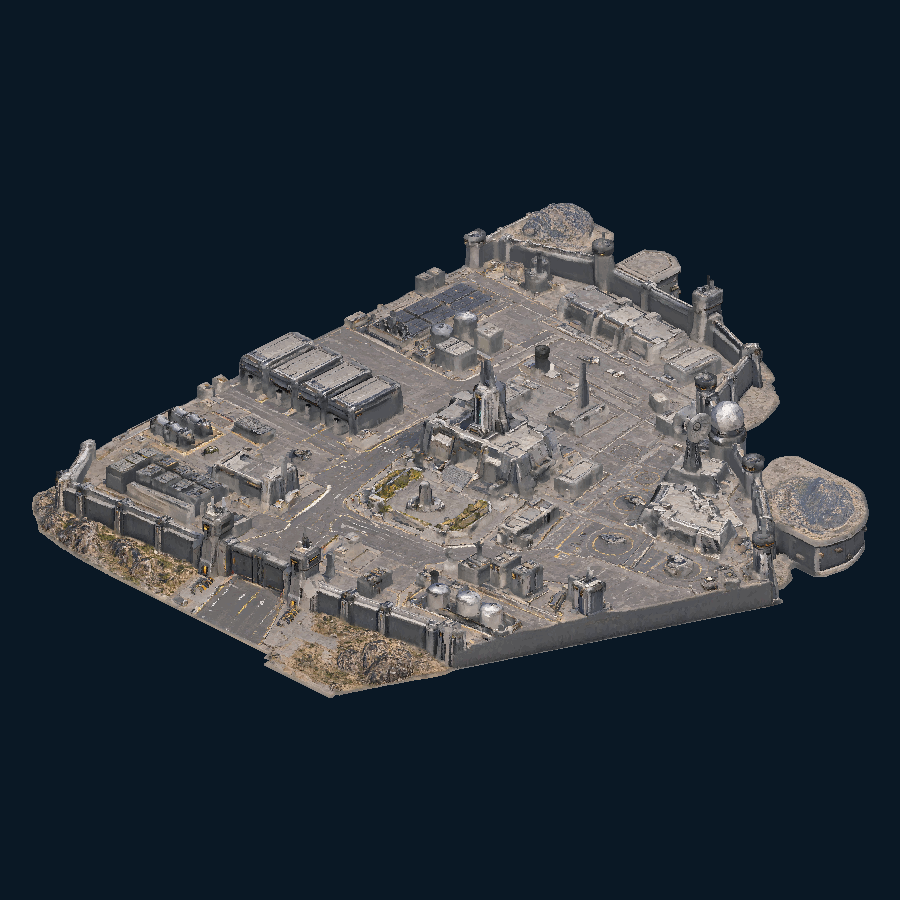
Veltrion Base is a Human ground installation combining regional command, protected stores, maintenance compounds and layered local defense. A walled 600 m × 600 m compound organizes its facilities around internal service roads and a central command complex. Its value lies in keeping nearby formations supplied, coordinated and ready to return to action.
Base Profile

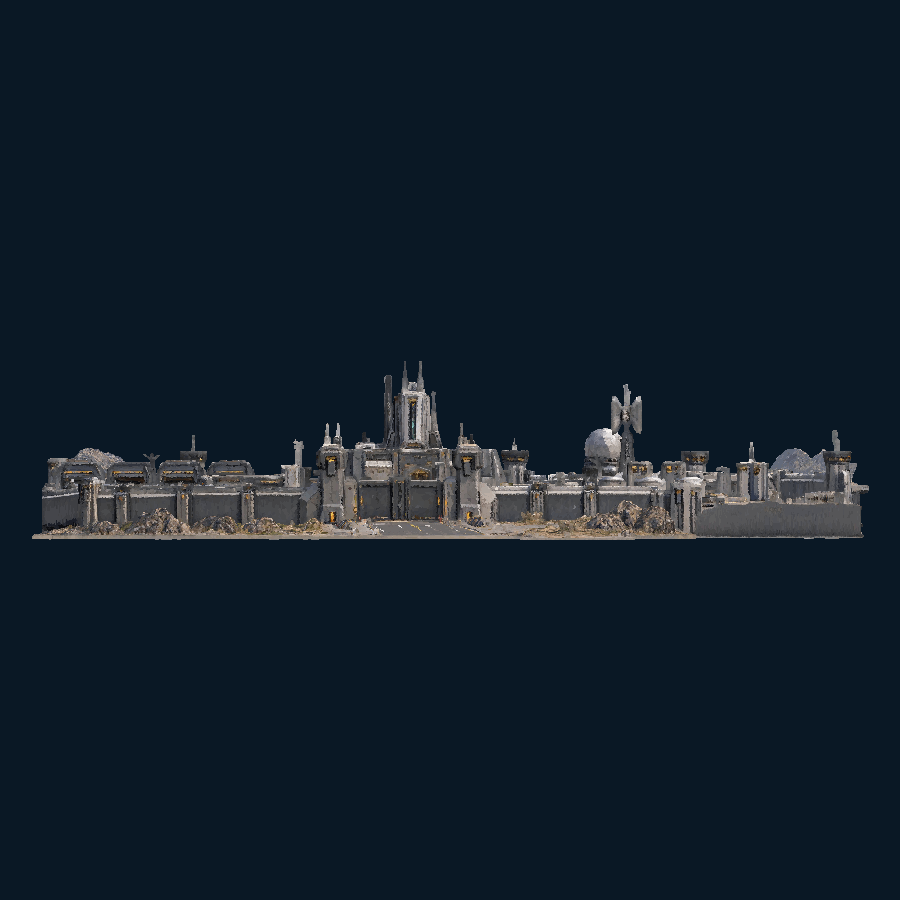
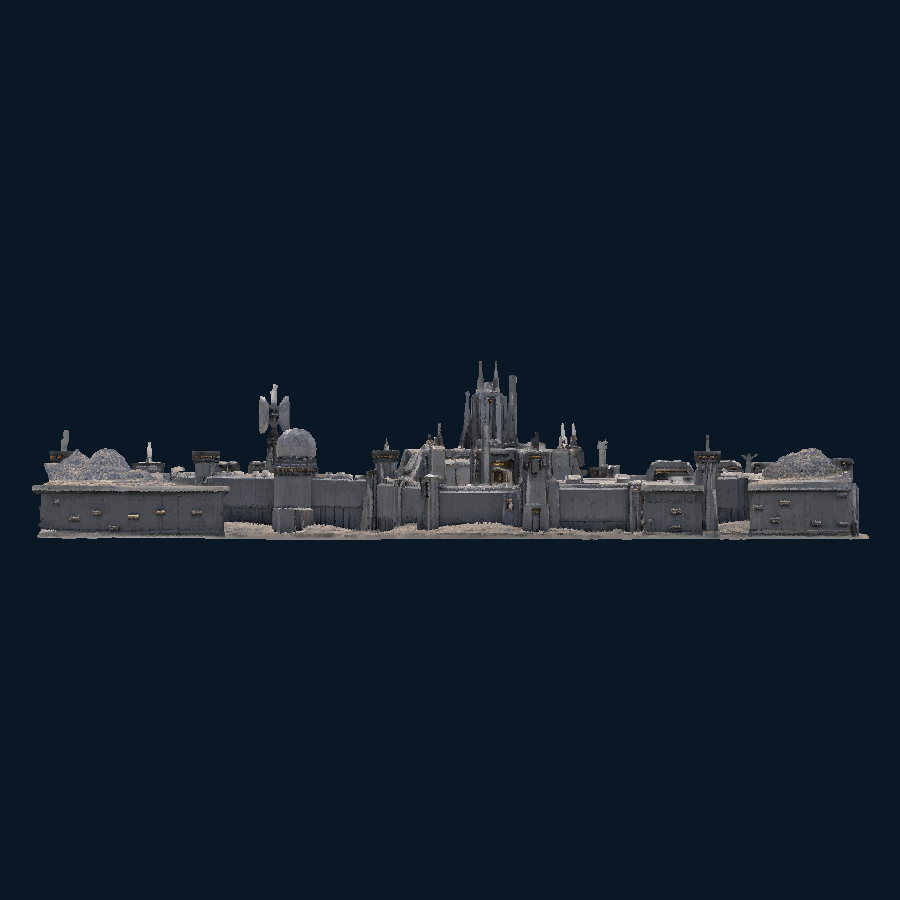
Dimensions & Scale
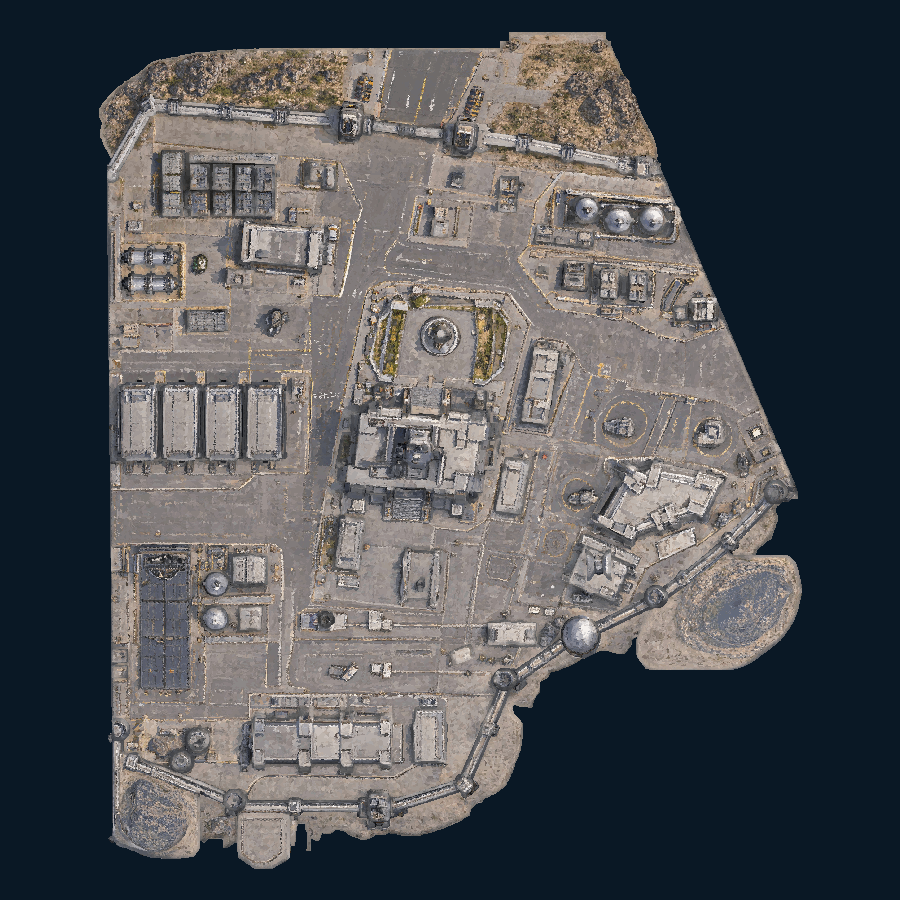
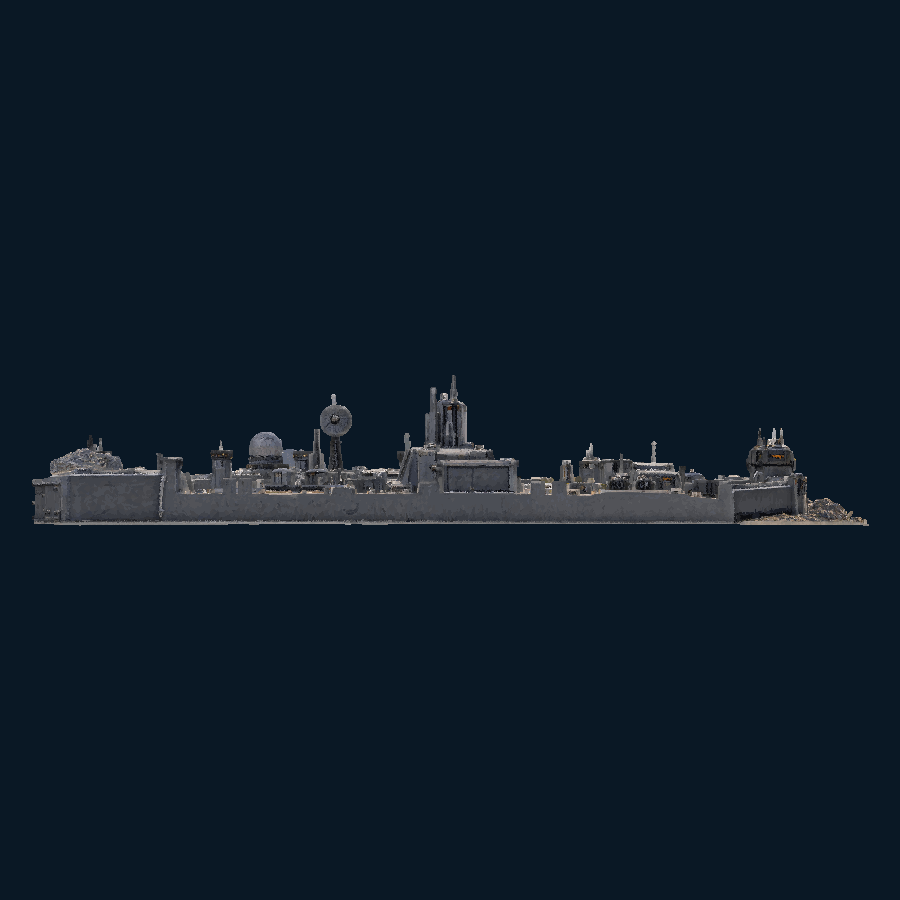
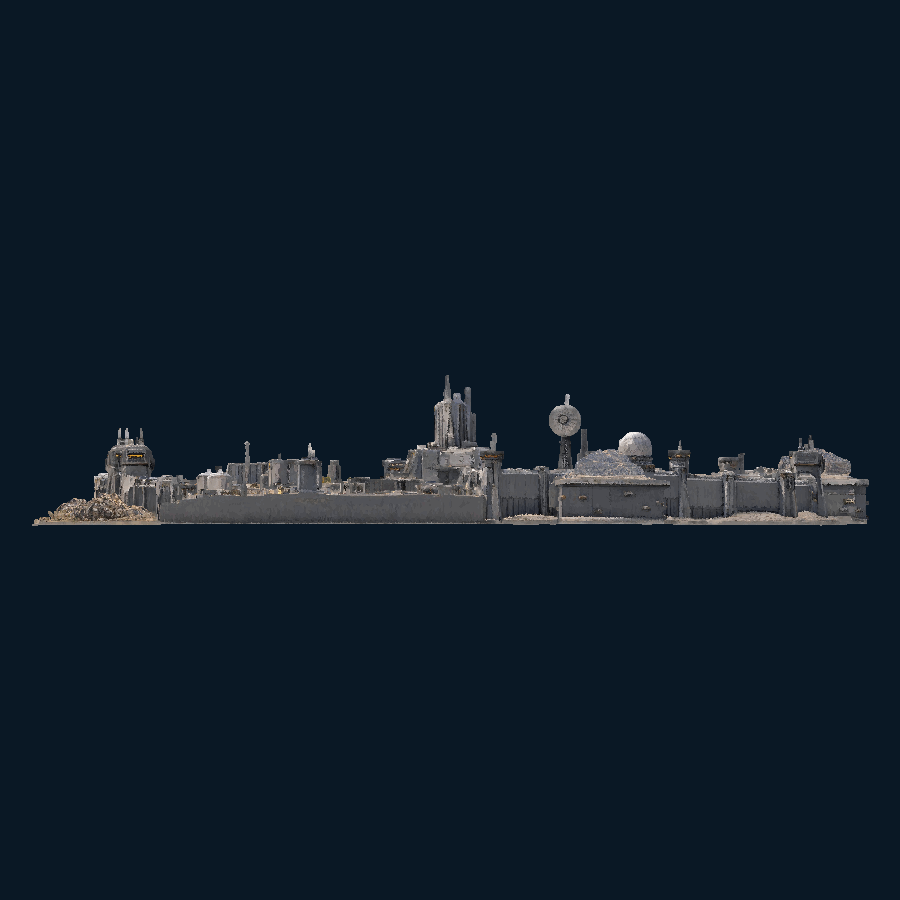
Length 600 m × Width 600 m × Height 110 m (approximate). The 600 m × 600 m planning footprint is an authored concept scale and includes the compound and its perimeter works. Height includes the tallest communication or observation structure.
The source geometry has a vertical-to-longest-horizontal proportion of approximately 0.18, suggesting about 108 m at a 600 m long edge; 110 m is the rounded concept height. The square planning footprint is a setting choice rather than an exact survey of the irregular modeled boundary.
Weapons & Armament
Proposed fictional armament: protected local-defense cannon positions associated with the perimeter emplacements, compact close-defense guns around critical infrastructure, and coordinated defensive fire directed by the command network. Local batteries discourage ground assaults and protect the immediate airspace; they do not provide strategic bombardment or independent orbital denial.
The model shows defensive positions and raised fixtures, but does not resolve weapon mechanisms or calibers. These assignments describe the intended game-world configuration; exact gun counts, ranges and ammunition are deliberately unspecified.
External Anatomy
An irregular armored perimeter encloses a broad compound of low buildings, service yards, storage blocks and connecting roads. A taller central complex anchors the layout, while large dish-like structures, elevated communication fixtures and rounded storage vessels occupy separate service areas. Open paved spaces give repair teams and supply traffic room to circulate.
Functional Architecture
Proposed systems combine area-surveillance radar, passive observation and directional communication around the visible dish-like structures and elevated fixtures. Their precise sensing modes are authored setting details rather than confirmed hardware identifications. A command network fuses reports and assigns local defensive coverage.
Distributed power, compartmented stores, maintenance bays, protected communications and reserve utilities sustain the garrison. Internal roads separate supply handling from the busiest command and repair areas, while local control stations preserve basic operations if central coordination is interrupted.
Technical Specifications
Offensive rating: 52/100 — Local combat batteries and close-defense guns provide limited offensive reach
Defensive rating: 78/100 — Prepared defenses and separated facilities improve resilience without granting invulnerability
Mobility rating: 0/100 — A permanent installation has no independent movement
Tactical cognition rating: 82/100 — Integrated radar, observation and communications support regional coordination
Endurance rating: 80/100 — Reserve utilities and stores sustain operations, but replenishment remains necessary
Fleet support rating: 90/100 — Repair, resupply and command services support several nearby formations
Operational Role
A regional ground command and sustainment base: substantial enough to coordinate several nearby formations, repair returning units and hold a defensive sector. It is a regional strongpoint rather than a planetary capital fortress. Its highest contribution is reliable logistics and coordinated protection of the forces operating around it.
Ground Operations
Veltrion Base is a fixed ground installation on the fictional frontier world of Vesper Reach, within the Ashglass Corridor defense zone. This is an authored Mow My World location with no intended correspondence to any place on Earth. Regional roads connect it to dispersed outposts and supply depots. Transported spacecraft or aircraft may receive ground support, but the installation itself has no flight or relocation capability.
Defense Architecture
Perimeter walls, separated defensive positions and controlled gateways slow a ground assault while the command network coordinates local response. Critical stores and service functions are distributed across separate structures to reduce a single failure spreading through the compound. Defensive strength depends on an alert garrison, maintained sensors and functioning supply routes; the concept does not assume an invulnerable shield.
Operational Limits
The installation cannot relocate. Roads, gateways and exposed service areas remain vulnerable to disruption, and its predictable position invites sustained pressure. Radar interference, damage to utilities or interruption of replenishment can gradually erode its advantages. Local defensive weapons cannot defeat every heavy attacker or replace protection supplied by mobile formations.
Strategic Strengths
A large service footprint supports repair, resupply and command in parallel. Separated storage and utility areas allow damaged sections to be isolated while other functions continue. The base can regroup scattered defenders and restore regional coordination after a retreat, making its logistical importance greater than its offensive reach.
Capability Assessment
Proposed fictional ratings use the same six-axis scale as the other archive entries. Defense, tactical cognition, endurance and support reflect the benefits of a prepared installation. Mobility is 0 because the base cannot move; this is an intentional property rather than an omitted score. The equal-weight overall grade is B, while its operational standing is a regional defense and logistics strongpoint. These are authored game-role ratings, not measured performance.
B · 63.7
Fleet-wide concept rating, 0–100; not simulated performance. Specialized strengths do not imply an equally high overall grade. Tactical Cognition describes sensing, coordination and command. Grade is the equal-weight mean: S ≥ 90, A ≥ 75, B ≥ 60, C ≥ 45, D < 45.
Technology Level
T0 — advanced planetary infrastructure with integrated sensing, command automation and distributed support systems. Ground support for visiting craft does not give the installation an independent space-travel tier.
Weapon Class
Proposed W1 — local combat batteries capable of engaging attacking units, backed by W0 close-defense systems. This is a local defensive assignment within the archive taxonomy, not a strategic theater or orbital weapon capability.
T0 planetary · T1 system flight · T2 phase travel · T3 limited world engineering. W0 point defense · W1 ship combat · W2 heavy fleet combat · W3 strategic theater systems. Technology and weapon classes are independent of the profile grade.
History & Lineage
Universe lore · authored service history
Origin
Established in the fictional Ashglass Corridor on Vesper Reach to unite scattered Human repair sites, supply stores and command posts into a defensible regional hub. Its layout prioritizes keeping a field force operational through repeated disruption.
Lineage & Branch
Human ground installations — regional command, defense and sustainment branch. Veltrion Base uses manufactured structures, compartmented service areas and networked local defenses adapted to an enduring ground presence.
Fleet or Unit
Human — Vesper Reach Regional Defense Group and its attached logistics, engineering and communications units. All organizational names are fictional setting elements.
Individual History
The Ashglass Corridor War — In this authored service history, Veltrion Base first supports Human formations defending the corridor against repeated Bugvex incursions. Its workshops restore damaged vehicles while its command staff coordinates relief between isolated outposts. The garrison holds the compound through several local assaults, but disrupted supply routes force careful rationing and the closure of damaged storage areas.
The Broken Relay Defense — When the regional communications chain fails, Veltrion Base becomes a temporary coordination center for withdrawing units. Local sensors and surviving relays rebuild a shared picture of the defensive zone. The installation shelters maintenance teams and directs mobile units toward threatened approaches without claiming control of the entire theater.
The Defense Reorganization — After the fighting, the garrison divides its command network into independent sectors, disperses essential stores and assigns reserve repair capacity away from the central complex. Reopened roads reconnect the surviving outposts. Veltrion Base returns to service as the anchor of a reorganized regional defense, with stronger continuity of operations rather than a larger offensive arsenal.